
LC-MS
Per- and polyfluoroalkyl substances (PFAS) including perfluorooctanesulfonic acid (PFOS) are a large group of synthetic fluorinated chemicals known for exceptional stability. Their persistence enables bioaccumulation in the environment, ultimately entering the food chain. Liquid chromatography coupled with tandem mass spectrometry (LC-MS/MS) is the method of choice for PFOS determination. Nevertheless, accurate quantification in food matrices remains challenging due to matrix-derived interferences. This Application Note, based on the work of Takayama et al. [1], demonstrates the effective separation of PFOS from these interfering compounds using the YMC Accura Triart C18 column with a (bio)inert coating in LC-MS/MS analysis.
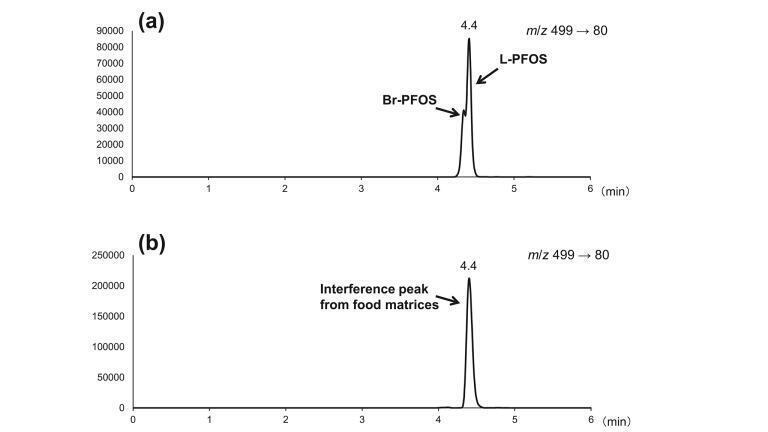
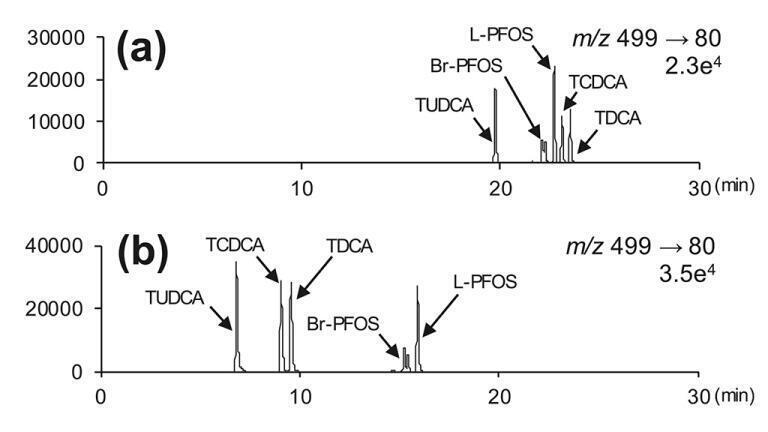
Naturally occurring cholic acid–related compounds, especially taurocholic acid isomers, are present in animal-derived foods such as meat, fish, and eggs. In negative electrospray ionisation mode, these compounds can generate the same selected reaction monitoring (SRM) transition as PFOS (m/z 499 → 80). Without sufficient chromatographic separation, this overlap can lead to false positive results and compromised data quality. A critical factor in method development was the evaluation of the organic solvent used in the mobile phase. Methanol is commonly employed in PFAS analysis due to its strong retention and favourable ionisation behaviour. However, under methanol-based conditions, PFOS co-eluted with several taurocholic acid isomers, including TUDCA, TCDCA, and TDCA, making selective detection impossible.
Switching to a methanol-free mobile phase using acetonitrile as the organic solvent resulted in a decisive improvement. Under these conditions, PFOS were completely separated from all taurocholic acid isomers, clearly demonstrating that full selectivity can only be achieved using a methanol-free approach. Among seven columns evaluated, the (bio)inert coated YMC Accura Triart C18 column provided the best overall performance and was therefore selected for all subsequent analyses.
Using the optimised LC-MS/MS method, a 21-component PFAS mixture was successfully separated, with well-resolved peaks for both carboxylate- and sulfonate-type PFAS. Short- and mid-chain PFAS (C4–C9) showed sharp peak shapes and strong signal intensities, enabling sensitive and reliable quantification. Although long-chain PFAS eluted later in the gradient and exhibited lower responses, they remained clearly identifiable.
Method performance was further confirmed through recovery studies in real food matrices. At low spike levels of 0.1 and 1 ng/g, recoveries for C4–C9 PFAS consistently ranged between 80 and 120%, with relative standard deviations below 15%. Importantly, analysis of unspiked samples showed that endogenous taurocholic acid–related compounds eluted well before PFOS, confirming complete separation from potential interferences.
Overall, the combination of a methanol-free LC-MS/MS method with the inert YMC Accura Triart C18 column provides a robust and reliable platform for interference-free PFAS analysis in complex food matrices.
[1] T. Takayama, A. Shingu, S. Kato, R. Nagatomo, T. Tsutsumi, K. Inoue, Countermeasure for interfered monitoring ion of perfluorooc¬tanesulfonic acid (PFOS) from intrinsic food samples based on LC-MS/MS analysis of per- and polyfluoroalkyl substances, J. Food Compos. Anal., 2024, 133, 106436


 Product directory























.jpg)