Purification
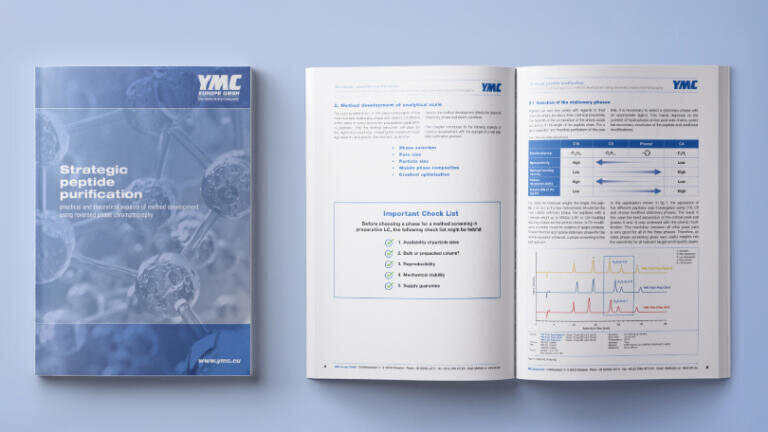
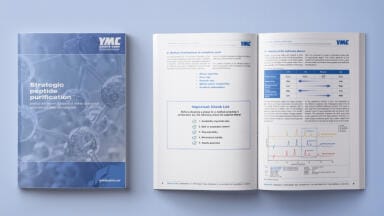
Peptide purification is rarely “just a downstream step” - it often determines whether a process will be productive, robust, and economically viable. With peptides varying widely in size, hydrophobicity, secondary structure, and impurity profiles, a one-size-fits-all approach can quickly lead to low recovery, long cycle times, and costly rework. Our helpful Whitepaper “Strategic Peptide Purification” provides a structured, practice-driven guide to method development using reversed phase chromatography, designed to help you reach your purity and yield targets faster.
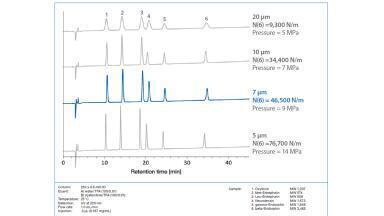
Instead of generic theory, the Whitepaper walks you through a proven workflow for preparative peptide purification - balancing maximum sample recovery, shortest cycle time, and cost limitations. You’ll learn how to build selectivity from the ground up by optimising the key variables that truly drive preparative success: stationary phase choice, pore size, particle size, mobile phase composition, and gradient design.
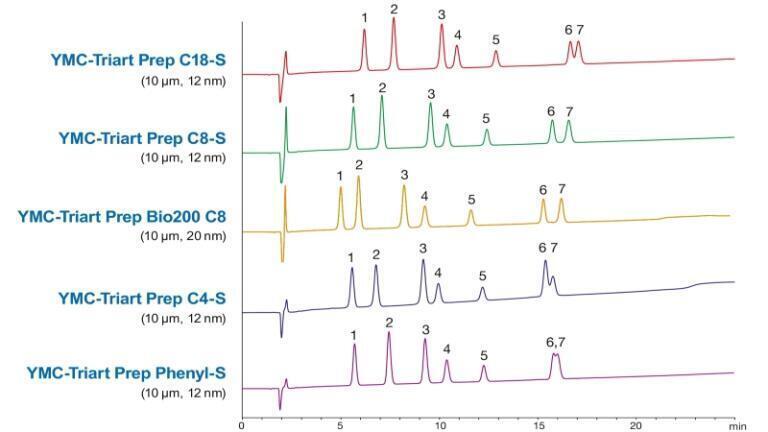
The foundation of every efficient peptide purification is selectivity - because only the right combination of stationary phase and elution conditions enables high loading capacity without sacrificing yield. The Whitepaper provides practical selection tools and screening approaches, including clear comparisons of C18, C8, phenyl, and C4 chemistries and how peptide characteristics influence the optimal choice.
Many phase screenings rely only on analytical loading to identify the stationary phase with the best resolution. However, strong analytical performance doesn’t always translate to preparative scale. Loadability is driven by the stationary phase characteristics as well as the peptide’s properties and impurity profile. Since preparative workflows require higher sample feed, loadability should be assessed early in phase screening to ensure scalable performance and economic viability. In our whitepaper, we show how integrating high-loading studies into phase screening helps identify the stationary phase that delivers both high resolution and consistent purity.
A major highlight: the entire strategy is illustrated using a real-life GLP-1 process development example - purification of liraglutide. This means you don’t just read about what to do - you see how decisions impact critical peak separation, loading behavior, and practical scale-up readiness under realistic conditions.
YMC combines deep chromatographic know-how with application support that goes far beyond materials alone. This Whitepaper reflects our hands-on expertise in peptide purification challenges - from method screening to scaling and practical robustness. And if you need more than guidance, YMC also offers training, packed-column services, and tailored support for your purification goals.
If you want to speed up method development, improve purity and recovery, and build a peptide process that scales reliably, this whitepaper is your roadmap. Request your copy now, and turn peptide purification into a predictable, high-performing workflow.

 Product directory



















.jpg)
.jpg)