
Columns (LC)
Sustainability has become one of the defining trends in modern pharmaceutical manufacturing, and preparative liquid chromatography is no exception. As purification processes continue to scale, the large volumes of organic solvents consumed during downstream processing increasingly influence both production costs and environmental impact. While acetonitrile remains the benchmark organic modifier for reversed-phase chromatography, its toxicity, disposal requirements, and supply-chain challenges have accelerated the search for greener alternatives. The question facing process developers is no longer whether sustainable solvents can be used, but whether they can deliver comparable chromatographic performance under demanding preparative conditions.
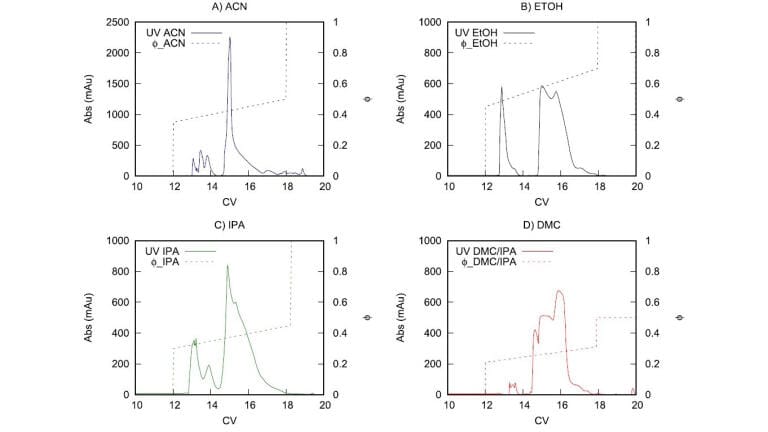
This Application Note compares conventional acetonitrile with three alternative organic modifiers - ethanol, isopropanol, and a mixture of dimethyl carbonate (DMC) and isopropanol - for the preparative purification of melittin from honeybee venom. All experiments were performed under identical chromatographic conditions on a YMC-Triart Prep C18-S column, allowing a direct comparison of purity, yield, solvent consumption, productivity, and established green chemistry metrics such as AGREE, AMGS, ChlorTox, and CHEMS-1.
The comparison demonstrate that greener solvent systems can provide chromatographic performance comparable to acetonitrile while reducing solvent consumption and improving sustainability. In particular, isopropanol and the DMC/IPA mixture achieved high product purity and recovery together with a more favorable environmental profile. The DMC/IPA system showed the best overall balance between chromatographic performance and sustainability among the solvent systems investigated.
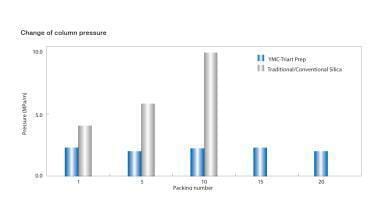
An important factor enabling this transition is the robustness of modern stationary phases. Preparative chromatography often demands reliable performance despite changes in solvent composition, viscosity, and operating conditions. YMC-Triart Prep C18-S provides the mechanical and chemical stability required for these challenging applications, allowing process developers to evaluate alternative eluents with confidence while maintaining reproducible separations. This robustness is particularly valuable as manufacturers increasingly seek to implement greener purification strategies without introducing additional process risks.
Based on experimental data published by the University of Ferrara, this Application Note provides practical guidance for scientists evaluating greener solvent systems in preparative reversed-phase chromatography. The results show that carefully selected alternative eluents can reduce solvent consumption while maintaining the purity and recovery required for preparative applications, supporting a more sustainable approach to process development.


 Product directory























.jpg)