
Columns (LC)
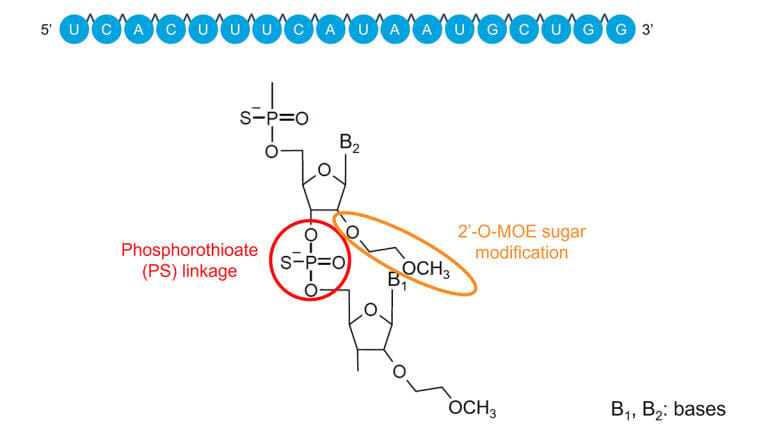
Robust analytical methods are essential for the quality control of therapeutic oligonucleotides, whose complex chemistry gives rise to challenging impurity profiles. This Application Note demonstrates high-resolution IP-RP LC analysis of nusinersen and its related impurities using the bioinert-coated YMC Accura Triart Bio C18 wide-pore column, combined with an optimised LC-MS workflow for confident impurity identification.
A systematic evaluation of the key chromatographic parameters influencing the separation of nusinersen and its associated impurities identifies optimal IP-RP LC conditions. The bioinert-coated YMC Accura Triart Bio C18 column provides an ideal platform for oligonucleotide analysis by minimising secondary interactions with metal surfaces while the wide-pore YMC-Triart Bio C18 stationary phase delivers sharp peaks and high-resolution separations of complex impurity profiles. The effects of column temperature, organic solvent composition and ion-pair reagent selection are investigated to maximise separation performance. Increasing the column temperature from 30°C to 70°C reduces retention time, sharpens peak shapes and improves the separation of both early- and late-eluting impurities, while no further improvement is observed at 85°C, making 70°C the preferred operating temperature.
Different organic modifiers, including acetonitrile, methanol, ethanol and isopropanol (IPA), are also evaluated. While acetonitrile effectively separates early-eluting impurities, stronger solvent systems produce progressively sharper peaks. 100% IPA delivers the best overall performance, combining excellent peak sharpness with efficient resolution of early-eluting impurity species.
To further optimise selectivity, four ion-pair reagents of increasing hydrophobicity, namely TEA, DIPEA, DBA and HA, are compared. Although peak shapes remain consistent across all reagents, increasing hydrophobicity enhances retention and impurity resolution. Hexylamine (HA) provides the strongest retention of nusinersen and the highest resolution of early-eluting impurities, making it the preferred ion-pair reagent for the analysis of nusinersen.
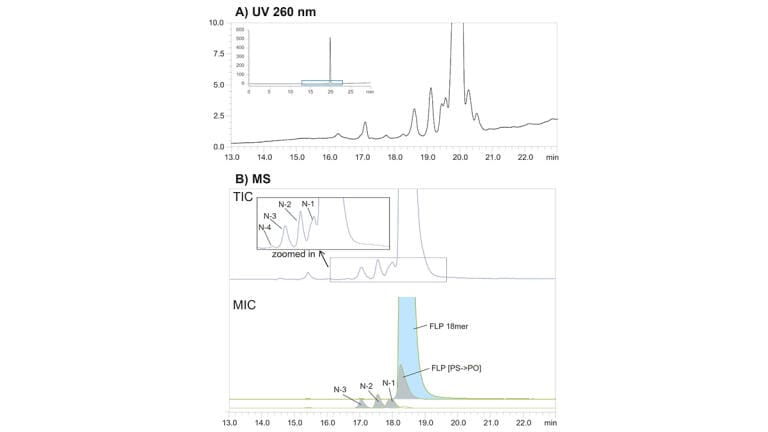
The optimised IP-RP LC method seamlessly integrates with mass spectrometry, enabling confident identification of nusinersen-related impurities. LC-MS resolves and identifies the truncated N-1, N-2 and N-3 species, while an additional N-4 impurity is only detected in the total ion chromatogram. The analysis also reveals a co-eluting phosphodiester variant of the main analyte, highlighting a recognised challenge in the analysis of phosphorothioate-modified oligonucleotides. Despite this limitation, the optimised workflow provides comprehensive impurity profiling and demonstrates the excellent resolving power of the YMC Accura Triart Bio C18 column for complex oligonucleotide samples. Furthermore, the analytical approach is readily applicable to a broad range of therapeutic oligonucleotides beyond nusinersen.

 Product directory

















.jpg)
.jpg)