LC-MS
Published over 13 years ago. See the latest and most current information on LC-MS.
Extraordinary sensitivity in the world´s fastest triple quadrupole mass spectrometer.
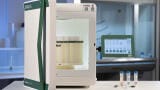
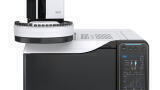
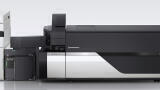
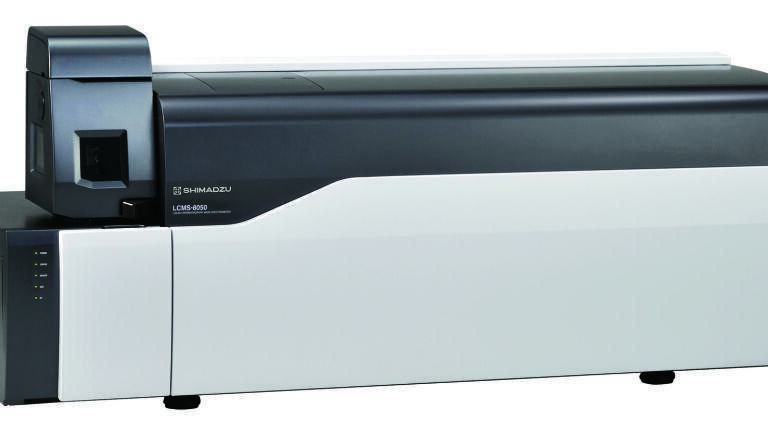
Shimadzu, one of the world leaders in analytical instrumentation, will release the LCMS-8050, a triple quadrupole LCMS/MS. This new system incorporates proprietary ultrafast technologies as well as a newly developed ion source and collision cell technology. As the flagship model of Shimadzu’s UFMS (Ultra-Fast Mass Spectrometry) product line, the LCMS-8050 features high sensitivity, high data quality and the world’s fastest data acquisition rates.
The LCMS-8050 meets the growing demand for trace-level quantitation in clinical research and other markets. Its world premiere will be at the TIAFT (The International Association of Forensic Toxicologists) conference in Portugal on September 2 - 6, 2013.
Smaller inlet leads to lower cost-of-ownership
Delivering attogram-level (10-18 grams) sensitivity and possessing unsurpassed ruggedness, the LCMS-8050 achieves its improved sensitivity through two important technologies:
One common design approach to increase sensitivity in mass spectrometers has been to incorporate a larger inlet to increase the number of ions introduced into the instrument. This approach necessitates the inclusion of a more powerful and more costly vacuum system. However, replacing vacuum pumps is inevitable and expensive, and a larger inlet leads to increased levels of instrument contamination. For these reasons, Shimadzu has maintained a smaller inlet in the LCMS-8050. When combined with the new heated ESI source and UFsweeper III, system performance improves and cost-of-ownership is reduced.
The world’s fastest data acquisition rates
The newly engineered high voltage power supply enables a maximum scan rate of 30,000 u/sec and a 5 msec polarity switching time, making the LCMS-8050 combined with Nexera UHPLC the ideal platform for laboratory productivity. It is now possible to include 1,000 events with up to 32 channels per event for a maximum of 32,000 MRMs per analysis.
User-friendly Operation and Easy Maintenance

 Product directory