LC-MS
Researchers have adapted Orbitrap secondary ion mass spectrometry to distinguish and spatially map sugar molecules that share the same formula and molecular mass
Researchers have demonstrated that Orbitrap secondary ion mass spectrometry can distinguish and map structural isomers directly on surfaces, which could address a persistent source of ambiguity in mass-spectrometry imaging.
The team used differences in ion dissociation and gas-phase transmission to separate three trisaccharides that possess the same chemical formula and molecular mass. The approach has added structure-sensitive information to a technique that would ordinarily detect the compounds at an identical mass-to-charge ratio.
Structural isomers contain the same constituent atoms but differ in the arrangement of their chemical bonds. Those differences can alter molecular shape, biological recognition and function, yet they remain invisible when an analytical method relies on molecular mass alone.
This presents a particular problem for mass-spectrometry imaging, which seeks to identify compounds while retaining information about their position within a tissue, material or surface. Conventional chromatography or ion-mobility methods can separate isomers before mass analysis, but the separation step may remove the spatial context that imaging laboratories want to preserve.
The researchers examined raffinose, maltotriose and melezitose. All three sugars have the molecular formula C₁₈H₃₂O₁₆ and produced the same deprotonated molecular ion at a mass-to-charge ratio of 503.1617. Greater mass resolution alone therefore could not distinguish them.
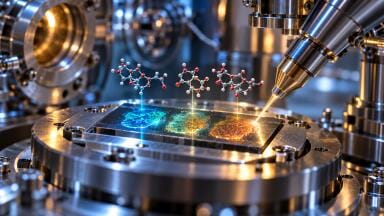
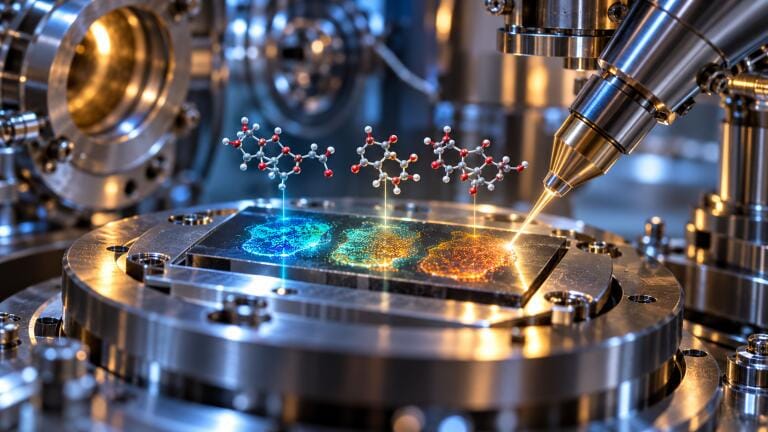
Orbitrap secondary ion mass spectrometry (OrbiSIMS) uses an ion beam to release secondary ions from a sample surface before an Orbitrap mass analyser measures them at high resolution. The instrument must transfer those ions through its optical system and a helium-filled collision cell before analysis.
The team found that this transfer process contained analytically useful information. Changes to the sample’s target potential altered ion transmission and dissociation in structure-dependent ways. The three trisaccharides consequently produced different voltage-dependent profiles, despite their identical molecular formulae.
Helium pressure within the collision cell provided another point of distinction. Molecules with different three-dimensional shapes have different collision cross-sections and therefore interact differently with the gas. Each isomer reached maximum transmission under different conditions.
The researchers compared the OrbiSIMS results with ion-mobility spectrometry, which separates ions according to their movement through a gas. The trends in optimal helium pressure corresponded with the drift-time differences measured by ion mobility, which supported the conclusion that molecular shape had influenced transmission.
Tests with mixtures of raffinose and maltotriose showed that the system could detect features from both compounds. The relationship between spectral response and mixture composition was not consistently linear, however. The researchers attributed part of this limitation to ion suppression, through which one component affects the ionisation or detection of another.
The team then deposited the sugars on surfaces and used selected target potentials and fragment-ion signals to distinguish their spatial distributions. OrbiSIMS successfully resolved raffinose and maltotriose in adjacent deposits and mixed samples, demonstrating that the structural information could form an imaging contrast rather than remain restricted to bulk spectral analysis.
The advance could prove valuable for glycomics, lipidomics, metabolomics and biomaterials research. Isomeric carbohydrates, lipids and metabolites can perform markedly different biological functions, even though conventional mass-spectrometry images may assign them to the same molecular signal.
The study nevertheless represents a proof of concept based on three purified trisaccharides and relatively controlled surface preparations. Complex tissues contain many overlapping molecules, salts and matrix components that may affect fragmentation, transmission and ion suppression. Quantitative analysis will also require further work because signal intensity did not always correspond linearly with isomer proportion.
Instrument settings and data interpretation will need careful standardisation before laboratories can transfer the method reliably. Dr. Alexander Pirkl, a co-author from IONTOF, was employed by the manufacturer of the OrbiSIMS instrument used in the research, while the other authors declared no competing interests.
The work has shown that ion-transfer behaviour, which laboratories might otherwise treat as an instrumental condition, can supply information about molecular structure. If validated in complex biological samples, the method could allow researchers to identify where functionally distinct isomers occur without sacrificing the spatial information preserved by surface analysis.
Dr. Margaret Moloney, Dr. Richard Paterson, Dr. Bin Yan, Dr. Jean-Luc Vorng, Dr. Ian Gilmore, Dr. Gustavo Trindade and colleagues at the National Physical Laboratory in London, UK, conducted the research with scientists from the University of Surrey in Guildford, the University of Oxford, the Francis Crick Institute in London, UK and instrument manufacturer IONTOF GmbH in Münster, Germany.
For further reading please visit: 10.1038/s41467-026-78604-8

 Product directory