Sample preparation
Researchers in Japan have developed a reliable, economical and automation-friendly method to prepare blood and tissue samples for glycoproteomic analysis, with the potential to support the detection of disease-associated changes in proteins
A research team in Japan has developed a robust and cost-effective laboratory method that uses commercially available cellulose magnetic beads to prepare blood and tissue samples for glycoproteomic analysis. The technique could help scientists to examine disease-associated changes in glycoproteins and – in time – to identify biomarkers for conditions such as cancer.
Glycoproteins are proteins to which carbohydrate structures known as glycans have been attached. These molecules have important roles in communication between cells, immune responses and many other biological processes. Changes to their glycan structures can accompany disease which makes them valuable subjects for diagnostic and therapeutic research.
The research forms part of Japan’s Human Glycome Atlas Project, which began in April 2023. The national initiative aims to compile comprehensive information about human glycans, glycoproteins and their relationships with disease. Its planned knowledge base could provide researchers worldwide with a standardised resource for human glycome data.
To achieve this objective, the project requires methods that can prepare large numbers of biological samples rapidly, consistently and at reasonable cost. Glycoproteomics, the large-scale analysis of glycoproteins, can reveal which proteins carry glycans, where those glycans attach and what structures they possess. However, the preparation of suitable samples remains a major technical challenge.
Glycosylation is the biochemical process through which a cell attaches a glycan to a protein or lipid. It is one of the most common modifications that proteins undergo after their production. The position and structure of an attached glycan can influence a protein’s stability, activity and interactions with other molecules or cells.
Several diseases, including cancer, are associated with altered glycosylation patterns. Cancer does not simply damage glycans directly. Instead, disease-related changes in cellular metabolism and enzyme activity can affect how glycans are assembled and attached to proteins. The resulting glycoprotein patterns can provide measurable biological signs of disease and could therefore serve as biomarkers for diagnosis, patient classification or the assessment of treatment response.
One important analytical technique – known as bottom-up glycoproteomics – uses enzymes to cut glycoproteins into peptides. Peptides that retain attached glycans are called glycopeptides. Scientists can separate and concentrate these glycopeptides before they use mass spectrometry to determine their molecular composition.
The approach can supply both qualitative and quantitative information about the carrier protein, the precise glycosylation site and the composition of the attached glycan. In N-glycoproteomics, the analysis concentrates on glycans attached to the amino acid asparagine, which is represented by the letter N in biochemical notation.
Despite its scientific promise, bottom-up glycoproteomics can be difficult to apply to complex biological samples. Non-glycosylated peptides are usually much more abundant than glycopeptides and can overwhelm the signals produced during mass spectrometry. Samples can also contain salts, detergents and other impurities that reduce the efficiency and reproducibility of enzymatic digestion and subsequent purification.
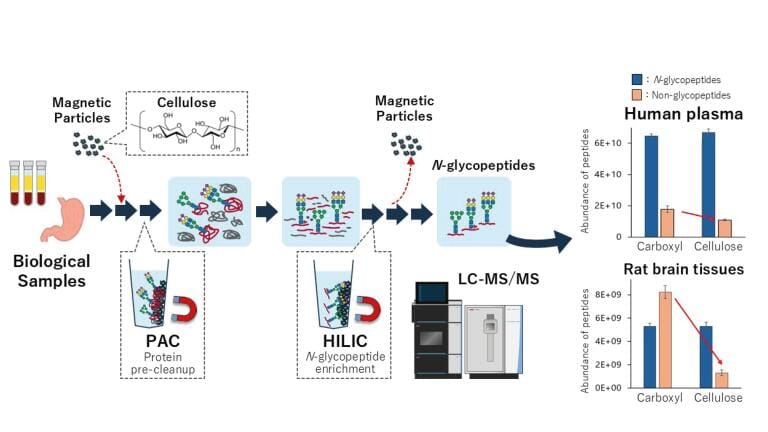
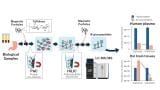
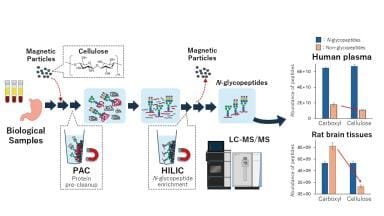
The researchers addressed these problems through a combination of two established preparation principles. The first was single-pot, solid-phase-enhanced sample preparation (SP3) which uses magnetic particles to capture proteins or peptides within a single reaction vessel. The method can reduce sample loss and is well suited to automated laboratory equipment.
The second principle was hydrophilic interaction liquid chromatography (HILIC). This separation technique exploits the affinity of water-attracting molecules for a hydrophilic surface. Because glycans contain numerous hydrophilic chemical groups, HILIC can help to retain glycopeptides while less hydrophilic, non-glycosylated peptides pass through.
The team compared two forms of commercially available magnetic particle: carboxylated polymer beads and a porous cellulose resin. The cellulose particles proved more effective as the solid phase for HILIC-based enrichment. They recovered a higher proportion of N-glycopeptides and removed non-glycosylated peptides more efficiently across several sample types.
The researchers first assessed the method with plasma and serum; the two principal liquid components of blood used in clinical analysis. They then applied it to tissue extracts. In comparison with digestion in solution, the single-tube method improved digestion efficiency and produced N-glycopeptide recovery comparable to that achieved through conventional HILIC solid-phase extraction.
The method also worked with serum from which the abundant proteins albumin and immunoglobulin had been removed. Such depletion can make less abundant molecules easier to detect and can therefore broaden the range of glycoproteins available for analysis.
To examine the method’s potential in disease research, the scientists applied it to clinical samples from people with gastric cancer. Their serum comparison included samples from 20 healthy donors and 10 patients with the disease. The analysis identified 1,984 N-glycopeptides derived from 150 glycoproteins and detected cancer-associated differences in glycosylation. These included previously reported alterations in acute-phase proteins such as alpha-1-acid glycoprotein and haemopexin.
These findings did not establish the method as a diagnostic test for gastric cancer. Further research with larger and more diverse patient groups would be necessary to determine whether any of the detected glycopeptides had sufficient sensitivity and specificity for clinical use. The results did, however, demonstrate that the preparation process could recover biologically relevant glycopeptides from complex clinical samples.
“The SP3-based N-glycopeptide preparation method using commercially available cellulose magnetic beads is a robust and automate-friendly approach for N-glycoproteomics,” said Professor Kazuki Nakajima of the Institute for Glyco-core Research at Gifu University, Gifu City, Japan.
Because magnetic particles can be moved and separated by robotic equipment, the technique could support the high-throughput preparation of the large sample collections required by the Human Glycome Atlas Project. The team has begun to develop an in-house, fully automated system that incorporates the protocol. It intends to apply the system to plasma, serum and tissue samples and to use it for more detailed glycoproteomic studies.
The researchers said they hoped that the method could contribute to a standardised international approach for the analysis of glycoproteomic profiles. Such standardisation would make it easier to compare results between laboratories and to assemble reliable catalogues of disease-associated glycans.
For further reading please visit: 10.1016/j.mcpro.2026.101638


 Product directory














.jpg)