Ion chromatography (IC)
Researchers have developed an alternative laboratory procedure to assess cadmium-113m as part of the wider programme to verify treated water before discharge
Researchers at the Japan Atomic Energy Agency have developed a novel method to assess radioactive cadmium in treated water from Fukushima Daiichi Nuclear Power Station without hydrochloric acid, which can corrode laboratory equipment.
The study evaluated cadmium-113m in water treated through the Advanced Liquid Processing System (ALPS). None of 18 samples collected during 2024–2025 contained detectable amounts.
A magnitude 9.0 earthquake and subsequent tsunami struck Japan’s Fukushima Daiichi Nuclear Power Station in March 2011. Flooding disabled power and cooling systems, causing three of its reactors to meltdown, with hydrogen explosions and the release of significant amounts of radioactive material. Tens of thousands of people had to be evacuated from the locality of the power plant. It was the worst civilian nuclear accident since Chernobyl, in Ukraine, USSR, in 1986.
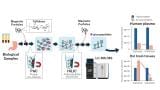
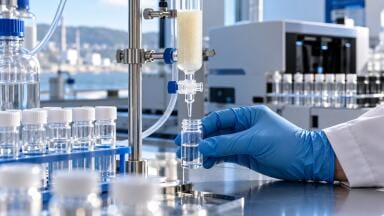
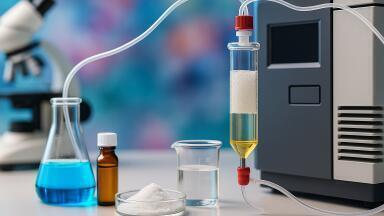
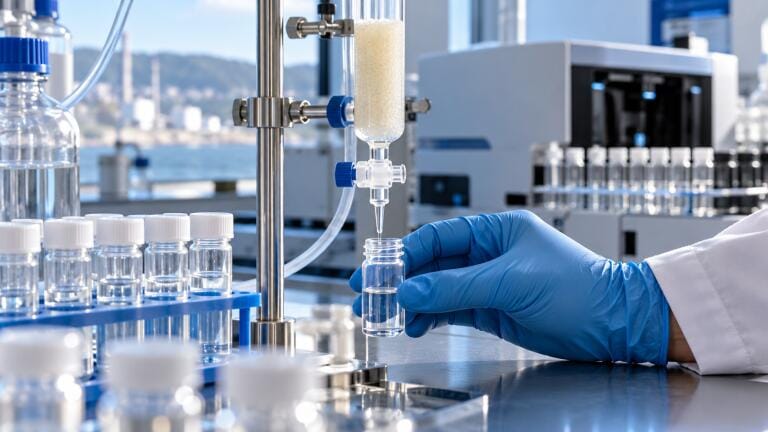
The study used HCl-free cation-exchange column chromatography to separate cadmium-113m. Samples were first pretreated using an Empore chelating disk to remove salts and concentrate the metals, then loaded onto a column containing 10 mL of Bio-Rad AG50W-X8 resin (100–200 mesh) converted to its sodium form. Cadmium was selectively eluted using 40 mL of 0.05 M sodium thiosulfate at a flow rate of 1 mL/min.
The procedure combined the chelating disc to remove salt with cation-exchange chromatography and sodium thiosulphate to separate cadmium. Liquid scintillation analysis achieved detection limits below 0.2 becquerels per litre, compared with the radionuclide’s regulatory concentration limit of 40 becquerels per litre. Average cadmium recovery from real samples was approximately 90 per cent.
The work addressed one analytical requirement within a much broader programme to characterise treated water before discharge. Tokyo Electric Power Company Holdings, the station’s operator, checks radioactive material concentrations at its measurement and confirmation facility before water is diluted and released. The Japan Atomic Energy Agency provides third-party analysis alongside an external organisation commissioned by the operator.
This arrangement places independent laboratory evidence within the release assessment, rather than reliance on a single organisation’s measurements. For laboratories, the practical task is to establish whether each target radionuclide meets the relevant analytical requirement within a complex programme of checks.
Japan’s Ministry of Economy, Trade and Industry has described a sequence that starts with treatment to reduce radionuclides other than tritium below regulatory limits. Seawater then provides substantial dilution before discharge, with subsequent checks of the marine environment. The ministry has identified analysis by both the operator and the Japan Atomic Energy Agency as part of the confirmation process.
Tritium requires a different approach because it is a radioactive form of hydrogen and can form part of water molecules. Japan’s Ministry of the Environment has explained that ALPS and other treatment equipment cannot remove it in the same way as other radioactive materials. Dilution therefore serves a separate purpose from the purification steps that target other radionuclides.
The ministry has also distinguished water that meets the definition of ALPS-treated water from stored water that still requires additional treatment. Water with radionuclides other than tritium above regulatory limits must undergo further purification before it qualifies for environmental discharge. This distinction helps explain why a result for one radionuclide cannot, by itself, establish compliance for an entire batch.
Independent comparisons between laboratories provide another layer of scrutiny. In its third comparison report – published in March 2025 – the International Atomic Energy Agency assessed results for treated-water samples collected in June 2024. Its assessment examined agreement between laboratories where measurable activities allowed comparison and compared detection limits where they did not.
The report recorded that cadmium-113m had been added to the operator’s source term in August 2024. That term identifies the radioactive material relevant to discharge assessment and helps define which radionuclides require analysis. The agency concluded that the operator had demonstrated strong analytical proficiency and that its selected methods were appropriate for their intended purpose.
For the cadmium study, however, important qualifications remained. A certified cadmium-113m standard was not available, so the researchers were unable to validate quantitative accuracy. They estimated detector efficiency from other radionuclides. Samples also required an overnight stabilisation period followed by a 16-hour measurement.
The immediate value is therefore a practical additional route for laboratories to investigate a specified contaminant, with explicit limits on what the evidence establishes. A result below a detection threshold describes the sensitivity of that analysis; it does not demonstrate absolute absence. Equally, a method for cadmium complements the wider assessment rather than replacing the full suite of radionuclide measurements and independent checks required before release.
Further validation would strengthen confidence in numerical results and help establish how consistently the procedure performs beyond the samples examined. For laboratory managers, this makes the distinction between a useful separation procedure and a fully validated quantitative assay central to any decision about adoption.
For further reading please read: 10.1007/s10967-026-11200-8

 Product directory