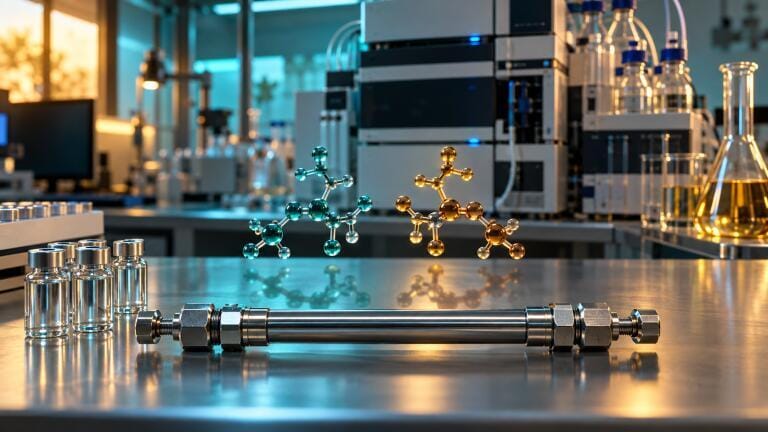
Supercritical fluid (SFC), green chromatography
A chromatographic study of synthetic cannabinoids has achieved baseline separation of enantiomers in two racemic samples, demonstrating a potentially valuable approach for forensic laboratories investigating stereochemical composition
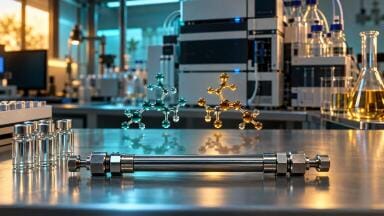
Researchers from the Department of Physical and Macromolecular Chemistry at Charles University in Prague, Czech Republic, used subcritical and supercritical fluid chromatography to distinguish between selected synthetic cannabinoid enantiomers.
The work addresses an important analytical limitation. Enantiomers have the same molecular formula but differ in their three-dimensional arrangement. Consequently, they can produce indistinguishable mass spectra under routine conditions, despite potentially having different biological effects.
The researchers examined 11 chiral synthetic cannabinoids obtained from internet vendors. High-performance liquid chromatography coupled with optical-rotation detection indicated that two of the samples were racemic, containing equal proportions of the two enantiomers.
The remaining samples did not display the same equal mixture. This finding highlights why laboratories should determine the stereochemical composition of a sample rather than infer it from its stated chemical identity.
Enantiomers are non-superimposable mirror images of a chiral molecule. Their distinction can be biologically significant because receptors and enzymes have three-dimensional binding environments and may interact differently with each form. Identifying a compound without establishing its enantiomeric composition may therefore provide an incomplete picture of its likely properties.
Using the supercritical-fluid method, the team achieved simultaneous baseline enantioseparation of both racemic samples. In a baseline separation, adjacent peaks are sufficiently resolved for the detector signal to return to the baseline between them.
This level of resolution enables more reliable assessment than partially overlapping peaks, particularly when laboratories need to determine the relative proportions of two enantiomers or detect a minor form in the presence of a dominant one.
Supercritical fluid chromatography commonly uses compressed carbon dioxide combined with an organic modifier as the mobile phase. Its separation behaviour is influenced by temperature, pressure and mobile-phase composition. The terminology can also encompass closely related subcritical conditions, making detailed reporting of operating parameters important for reproducibility between laboratories.
Successful chiral separation depends on creating an environment that interacts differently with each mirror-image form. A suitable chiral stationary phase can produce this distinction, causing the enantiomers to travel through the column at different rates. Performance therefore depends on the combined behaviour of the analyte, stationary phase and mobile phase – not simply on the type of instrument used.
The researchers also demonstrated an achiral separation using a specialised diol-bonded stationary phase. This approach can distinguish compounds according to chemical properties other than chirality and may be useful during an initial analytical survey.
However, achiral and chiral methods answer different questions. An achiral method can help establish which substances are present, but it will not necessarily resolve the two enantiomers of an individual compound. A dedicated enantiomeric separation may then be required to determine whether one form predominates or whether the material is racemic.
This complementary strategy could suit forensic workflows in which laboratories must first identify the constituents of an unknown sample and subsequently characterise the stereochemical composition of selected compounds.
Optical-rotation detection supplies additional evidence because chiral compounds rotate plane-polarised light. Its results nevertheless require careful interpretation. Without appropriate reference data, the direction or magnitude of optical rotation cannot establish every aspect of absolute molecular configuration. A weak net signal may also reflect the balance between multiple components rather than an absence of chiral material.
Mass spectrometry remains central to compound identification, but enantiomers have identical masses and can generate the same routine fragmentation patterns. Combining effective chiral chromatography with a suitable detector can therefore reveal information that mass analysis alone cannot provide.
Further work would be needed to confirm the method’s compatibility with mass-spectrometric detection and its suitability for quantitative forensic use.
Purchasing the compounds from online vendors gave the investigation relevance to materials circulating outside conventional reference-standard collections. However, these samples cannot represent the full variety and complexity of seized products or biological specimens.
Before routine quantitative use, laboratories would need to evaluate calibration, recovery, precision, stability and the reliable measurement of a minor enantiomer beside a substantially larger peak. They would also need to establish whether extraction, handling or storage could alter the enantiomeric composition before analysis.
The reported baseline separations provide a strong starting point. They demonstrate how chiral supercritical fluid chromatography could help forensic scientists move beyond basic compound identification and obtain a more complete description of synthetic cannabinoid samples.
For further reading please visit: 10.1002/elps.70149


 Product directory















.jpg)