Columns (LC)
In preparative chromatography, mechanical stability is not a “nice to have” - it is a decisive factor for performance, efficiency, and long-term cost control. As column dimensions increase and packing pressures rise, the physical robustness of the stationary phase directly determines column lifetime, backpressure behavior, and process reliability. This is exactly where YMC-Triart Prep sets a new benchmark.
Conventional silica materials are known to suffer from gradual particle degradation when exposed to pressure and shear forces. Over time, this leads to the formation of fines that clog frits and flow channels, causing a continuous increase in backpressure and ultimately limiting column usability. The problem becomes even more pronounced in preparative workflows that require frequent repacking - a common reality in modern production environments.
YMC-Triart Prep was specifically designed to overcome these limitations. Based on a hybrid silica technology, this stationary phase combines the separation performance of silica with outstanding mechanical robustness. Extensive packing studies clearly demonstrate that YMC-Triart Prep maintains its structural integrity even after repeated exposure to high mechanical stress.
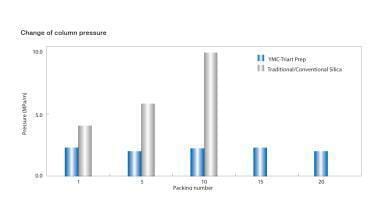
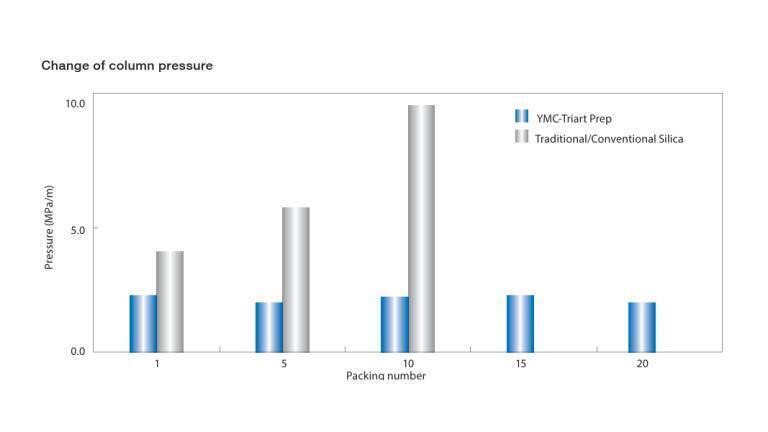
In dynamic axial compression (DAC) experiments, YMC-Triart Prep was repacked 20 consecutive times using the same material - without removing potential fines between cycles. The result: no measurable increase in backpressure over the entire repacking series. In contrast, conventional silica materials showed a sharp and continuous pressure rise after only a few packing cycles. This directly translates into longer usable column lifetimes and reduced downtime in routine operation.
The advantages are not limited to DAC packing. Hydraulic column packing experiments at 5 MPa and 10 MPa further confirm the exceptional mechanical stability of YMC-Triart Prep. Even under these elevated pressures, the particles show no signs of deformation or fragmentation. Scanning electron microscopy (SEM) images reveal highly regular particle shapes and an absence of fines - even after repeated high-pressure packing steps.
This structural integrity has a direct impact on chromatographic performance. The improved particle size distribution of YMC-Triart Prep enables an evenly packed column bed, resulting in lower backpressures, higher achievable flow rates, and consistent separation characteristics over extended periods of use. For preparative applications, this means higher throughput, improved process robustness, and significantly reduced material replacement costs.
Beyond performance and economics, mechanical stability is also a matter of sustainability. A stationary phase that can be used longer and repacked more often reduces material consumption and waste - an increasingly important consideration in modern chromatography operations.
If you want to see how these advantages translate into real, measurable data, the Technical Note provides a detailed look at the experimental setup, pressure profiles, and SEM analyses behind these claims. From pressure-versus-packing-cycle charts to side-by-side particle images, the data clearly show why YMC-Triart Prep is the ideal choice for demanding preparative chromatography applications.
Discover the full data and methodology in the Tech Note - and see mechanical stability make a measurable difference.


 Product directory