Liquid chromatography
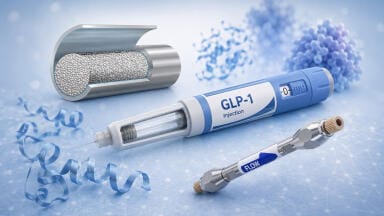
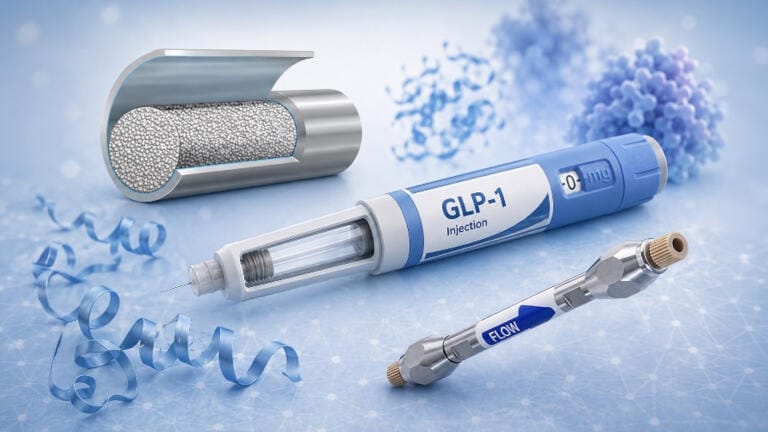
Peptide therapeutics, particularly glucagon-like peptide-1 (GLP-1) receptor agonists (RA), place increasing demands on chromatographic analysis. In addition to conventional method parameters, column hardware can significantly influence analytical performance. Interactions with stainless-steel surfaces can lead to adsorption, peak broadening and reduced sensitivity, especially for larger peptides. This Technical Note investigates the impact of column hardware on peptide analysis, with a particular focus on GLP-1 receptor agonists, and compares a conventional stainless-steel column with a bioinert-coated YMC Accura column.
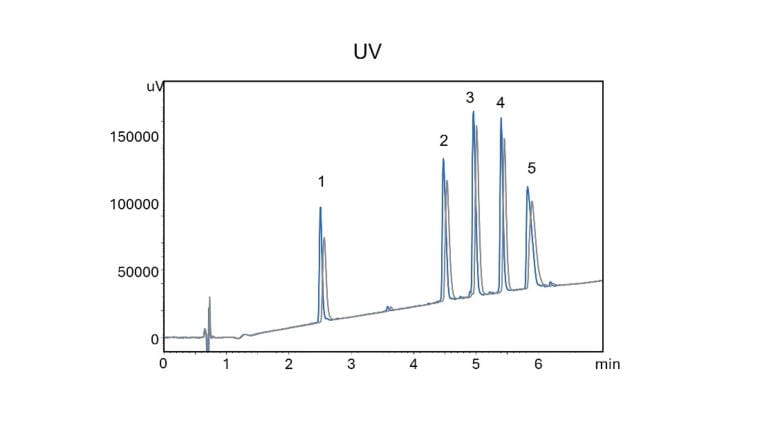
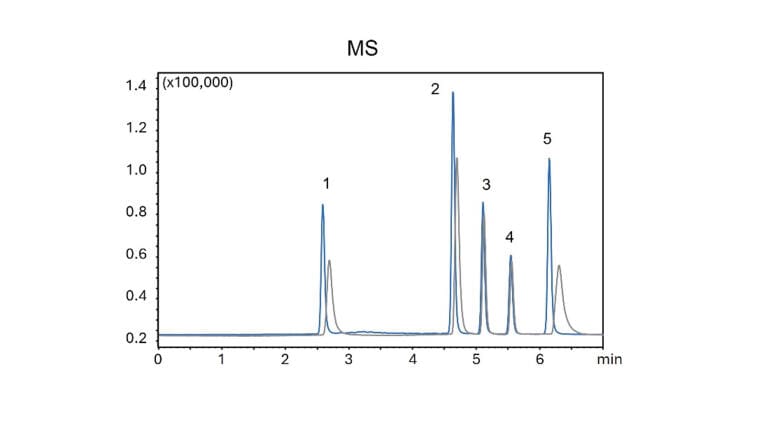
A broad range of peptides and proteins with different molecular weights and isoelectric points is investigated, including five GLP-1 RA. Under acidic conditions with 0.1% formic acid, stainless-steel hardware results primarily in broader peaks and reduced peak heights for the investigated GLP-1 RA. Under neutral conditions, reductions in both peak area and peak height suggest partial adsorption to stainless-steel surfaces. In contrast, only minor differences between stainless-steel and bioinert hardware are observed under basic conditions, highlighting how strongly hardware-related effects depend on mobile-phase pH.
The choice of acidic modifiers also affects chromatographic performance. Formic acid, commonly used for LC-MS applications, produces more pronounced hardware-dependent differences than TFA or DFA. When mobile-phase conditions are compared using semaglutide, retatrutide and tirzepatide, formic acid consistently produces the broadest peaks, while TFA and DFA considerably reduce peak widths. Neutral 20 mM ammonium acetate provides narrow peaks for all three analytes and is selected as the preferred condition for further GLP-1 RA analysis.
The benefits of bioinert hardware also extend to quantitative analysis. Under the optimised neutral conditions, calibration of tirzepatide over a concentration range of 5 to 500 µg/mL demonstrates excellent linearity with the YMC Accura Triart Bio C18 column. Hardware-related effects become particularly relevant at lower analyte concentrations, where interactions with stainless-steel surfaces have a greater relative impact on the detected signal. Eliminating these interactions therefore supports precise and consistent quantitative peptide analysis.
For LC-MS analysis under MS-compatible formic-acid conditions, the bioinert YMC Accura column provides sharper peaks and higher signal intensities for the investigated GLP-1 receptor agonists compared with conventional stainless-steel hardware. While the differences are already visible with UV detection, they become considerably more pronounced with MS detection. Here, considerably lower analyte concentrations are used, making interactions with metal surfaces more critical for the detected signal.
Overall, the Technical Note demonstrates that column hardware and mobile-phase composition are key parameters for reliable peptide analysis, particularly for high-molecular-weight GLP-1 receptor agonists. By suppressing unwanted metal-analyte interactions, the YMC Accura Triart Bio C18 column supports sharp peaks, improved sensitivity and consistent quantitative performance. This makes bioinert hardware a valuable choice for robust HPLC and sensitive LC-MS workflows in peptide analysis.



 Product directory