Purification
Biomolecules have been of great interest to research and industry for a long time. This trend is continuing, but the targets are constantly changing and with them the requirements for chromatographic purification strategies. YMC offers an innovative process resin that has been developed specifically for the purification of large biotherapeutics. Compared to other IEX resins, MacroSep IEX Q provides a macro-porous structure and an improved dynamic binding capacity (DBC) for these large molecules. The large pore size of 900 nm enables target molecules to diffuse properly to the binding sites. Only with this innovative macro-porous structure the required interaction with the stationary phase can be achieved. Therefore, it is the perfect addition to DSP platforms for a successful and productive purification.
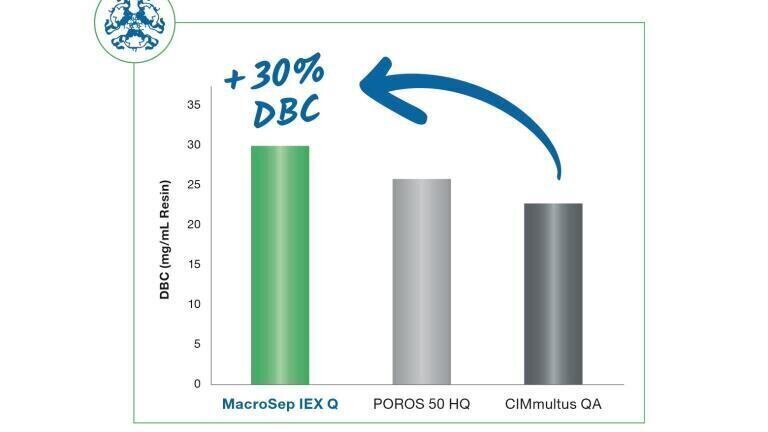
Since DBC is an important parameter, it is advisable to consider it when selecting an appropriate process resin. Although the DBC varies depending on the target molecule, values obtained using representative model compounds provide a useful basis for comparison. Therefore, the DBC values of three different AEX materials commonly used for the purification of large biomolecules were measured. For this study, the large protein complex Thyroglobulin with a molecular weight of 660 kDa was used. Based on the results MacroSep IEX Q shows the highest DBC. A larger amount of the protein complex could be bound to the resin before breakthrough was achieved. Compared to the other resins MacroSep IEX Q shows a 30% higher DBC making it the first-choice resin for the purification of large biomolecules.
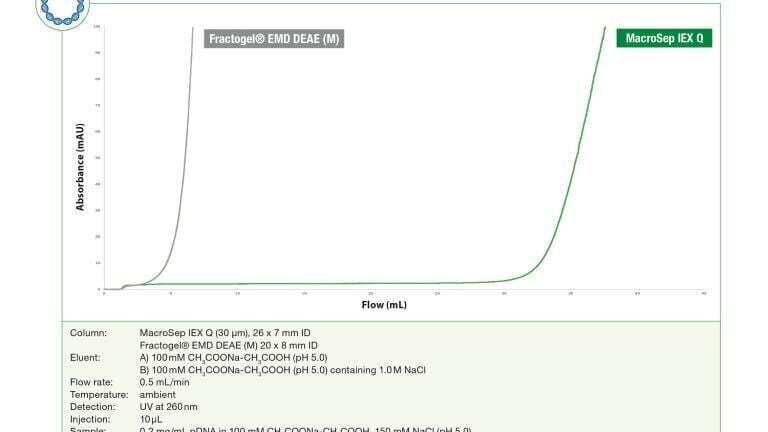
Plasmid DNA is also among the large biomolecules that have recently come into focus. Due to its size, resins with a standard pore size are unsuitable for purification of pDNA. The smaller pore size prevents the diffusion of large biomolecules into the pores. As a result, they can only interact with the functional groups located on the surface and the loadability is significantly reduced. The breakthrough curves of two different process resins for a pDNA with a size of 4.9 kbp are measured.
MacroSep IEX Q shows a later breakthrough of the pDNA compared to the alternative material exhibiting a pore size of about 80 nm. Therefore, the resin from YMC enables a significantly higher loading and thus contributes to a higher productivity of the overall process.
The dynamic binding capacity is an essential factor to increase the productivity of downstream processes. The higher the binding capacity, the higher is the maximum loadability of the target feed which consequently increases the throughput. The challenging purification of large biomolecules demands process resins that are precisely adapted to the corresponding requirements. In a direct comparison of the specified DBC values for pDNA and Thyroglobulin, MacroSep IEX Q clearly outperforms the alternative resins used for process scale and is therefore the ideal choice for every DSP platform.
Learn more in our TechNote

 Product directory














.jpg)