Ion chromatography (IC)
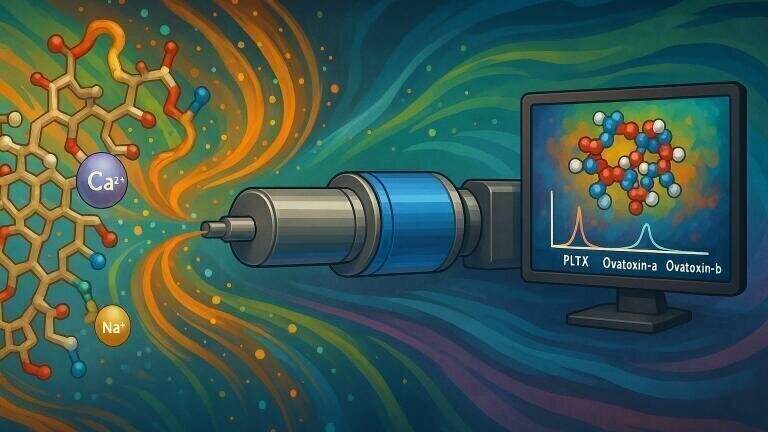
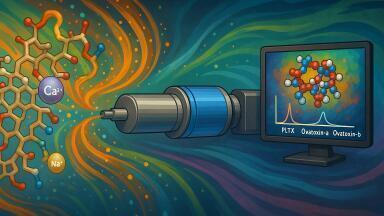
Palytoxin (PLTX) and its analogues from Ostreopsis cf. ovata are significant health concerns. They show potent vasoconstrictive properties, often causing seafood poisoning. PLTX analogues have chiral centers, resulting in many isomers, making their separation by liquid chromatography and identification/characterization by mass spectrometry challenging. This study explores for the first time the ion mobility spectrometry (IMS) behavior of these compounds to address these analytical challenges. Drift tube ion mobility spectrometry (DTIMS) and traveling wave ion mobility spectrometry (TWIMS) were used and compared.
Additionally, trapped ion mobility spectrometry (TIMS) and molecular dynamics simulation were employed to explain unexpected results. TIMS provided higher resolution, distinguishing isomeric ions generated in the electrospray source by losing water molecules from different toxin sites. Computational studies offered theoretical insights into the ion mobility of triply charged calcium and sodium adduct ions, suggesting a folded conformation. DTCCSN2 (collisional cross section using DTIMS and nitrogen as buffer gas) values were obtained for PLTX (standard), ovatoxin-a, and ovatoxin-b from microalgae samples in Sant Andreu de Llavaneres (Barcelona, Spain).
These values were comparable (ΔCCSs < 2%) to those measured with TWIMS calibrated using PLTX (standard). The study provides 102 CCS values from DTIMS and TWIMS data for adducts and fragment ions of PLTX analogues, which can be used as reference values in databases for toxin screening in complex samples.
Since the late 1990 s, the microalga Ostreopsis cf. ovata has proliferated on Mediterranean beaches [1–3]. This marine dinoflagellate produces different biotoxins, including isobaric palytoxin and its ovatoxin (OVXT) analogues, which vary depending on sea conditions. Palytoxin (PLTX), recognized as one of the most potent marine biotoxins, has been implicated in severe seafood poisoning in tropical regions and is increasingly concerning along the Mediterranean coast [4].
Currently, PLTX analogues are mainly determined by liquid chromatography-mass spectrometry (LC-MS) methods, which offer high separation and detection capabilities, comprehensive information on the chemical structure, and accurate, selective, and sensitive quantitative analysis. Different OVTX analogues (OVTX-a to OVTX‐i) produced by Ostreopsis have been identified through multiple-stage mass spectrometry (MSn) and high-resolution mass spectrometry (HRMS) [5, 6]. Additionally, the isobaric palytoxin produced by the microalga has been identified as a structural isomer of palytoxin produced by the coral Palythoa tuberculosa [7].
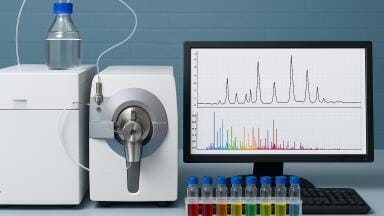
Over the past few decades, ion mobility-mass spectrometry (IM-MS) has emerged as a powerful analytical technique for the separation of gas-phase ions, enabling differentiation based on size, shape, and charge [8–10]. The integration of ion mobility spectrometry (IMS) with high-resolution mass spectrometry (HRMS) enhances both separation and identification capabilities, allowing for the unequivocal characterization of complex compounds. A key advantage of IMS is its ability to generate collision cross section (CCS) values, which are unique to each ion and correlate with its three-dimensional structure.
This capability is particularly valuable for distinguishing structural isomers, isobaric species, and characteristic fragment ions of palytoxin and ovatoxins, thereby providing critical insights into their conformational dynamics and structural complexity. Although PLTX and ovatoxins (OVTXs) share a similar chemical structure backbone, these molecules contain over 60 chiral centers, and their analogues differ in the positioning of the hydroxyl groups (Fig. 1), Such structural diversity poses significant challenges for separation and identification using conventional techniques [11].
These differences can markedly influence gas-phase conformations and, consequently, their ion mobility profiles. IMS is uniquely suited to detect these subtle structural variations, as shifts in hydroxyl group location and modifications in molecule conformation can alter the collision cross section (CCS) values, enabling differentiation of analogues based on their drift times. This project represents the first application of IM-MS to enhance isomer/isobaric separation and gain deeper insights into the conformation of palytoxin and ovatoxins. [Continued…]
To read the complete article click here:

 Product directory










.jpg)