HPLC, UHPLC
Published over 3 years ago. See the latest and most current information on HPLC, UHPLC.
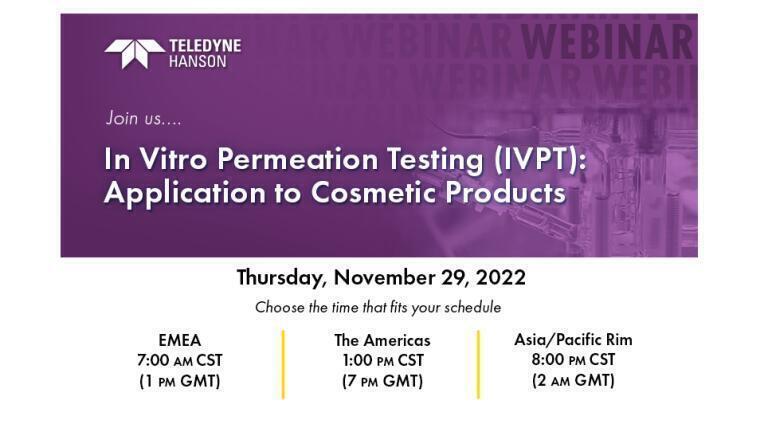
The objective of in vitro permeation testing (IVPT) is to measure the absorption and diffusion of cosmetic products/ingredients into and across the skin. Please join Teledyne Hanson and PKDERM for this informative 45-minute webinar, followed by an interactive Q&A offering you an opportunity to address your specific application.
Our speaker for this session is Hanan Osman-Ponchet, founder and CEO of PKDERM and an expert in IVPT testing.
During the webinar, you’ll learn how, when and why to perform IVPT in your lab, the differences between pharma and cosmetic testing, and the precautions to take when performing IVPT. IVPT is conducted using Franz-type diffusion cells and are performed according to OECD GD 428 and to SCCS/1358/10. Data generated using this predictive in vitro model are important for safety evaluation of cosmetic ingredients and are used to fill up the exposure and toxicological profile sections of the Cosmetic Product Safety Report as required by the EU Cosmetic Regulation 1223/2009.
We hope you can join us. Just click a time that works for you below to register.
Choose the time that fits your schedule
EMEA | 7:00 AM CST | (1 PM GMT) - Register Now
The Americas | 1:00 CST | (7 PM GMT) - Register Now
Asia/PacRim | 8:00 PM CST | (2 AM GMT) - Register Now


 Product directory