Columns (LC)
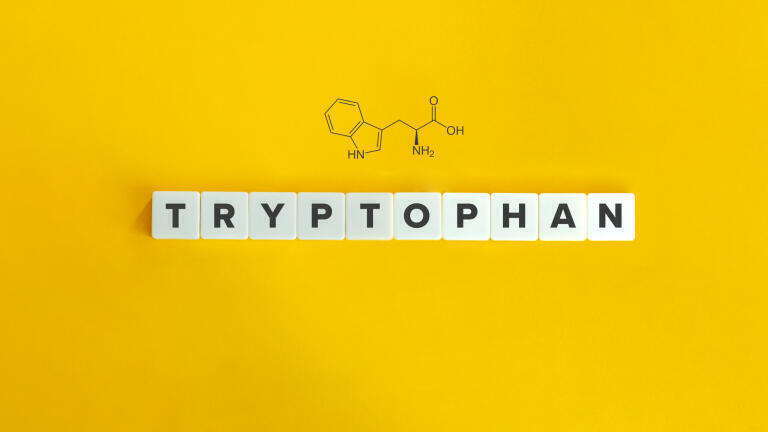
Tryptophan does not only function as a building block in the biosynthesis of proteins. It is also a central precursor of the kynurenine pathway which leads to the production of nicotinamide adenine dinucleotide (NAD) due to the intermediate quinolinic acid. This is not the only reason why accurate analytical monitoring of tryptophan and its metabolites is desirable. Furthermore, a disruption of the kynurenine pathway affects the synthesis of serotonin and melatonin. In addition to a genetic cause, an inflammatory induced disruption is also associated with psychiatric disorders. Elevated kynurenine concentrations serve as peripheral markers and may reflect central nervous system inflammation.
The coordinating compounds in the pathway pose a challenge for conventional analytical setups, as nonspecific absorption leads to peak tailing and reduced recovery. This Application Note outlines a robust method for the quantification of all relevant metabolites in the kynurenine pathway. The approach uses a bioinert YMC Accura Triart C18 column, designed to minimise undesired interactions and ensure reproducible performance across complex biological matrices.
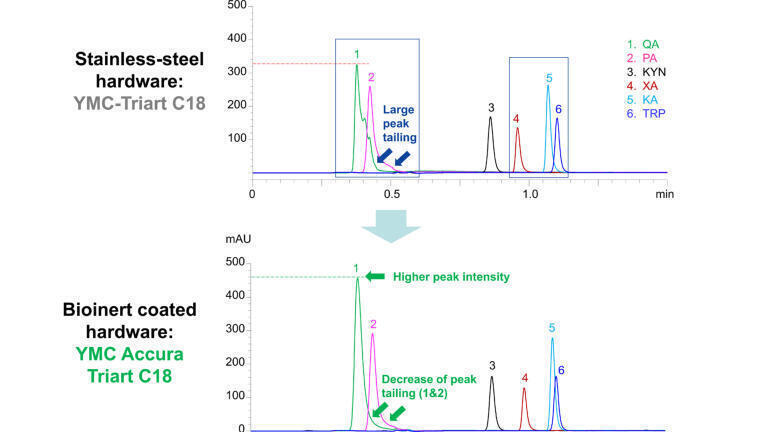
Figure 2 illustrates the comparison between conventional stainless-steel and bioinert coated YMC Accura hardware. While XA and KA are hardly affected by the stainless-steel hardware, QA and PA show massive peak tailing and reduced recovery. By using the bioinert coated YMC Accura Triart C18 column, peak tailing can be significantly improved and a higher peak sensitivity can be achieved. Tailing factors for all coordinating compounds are improved.
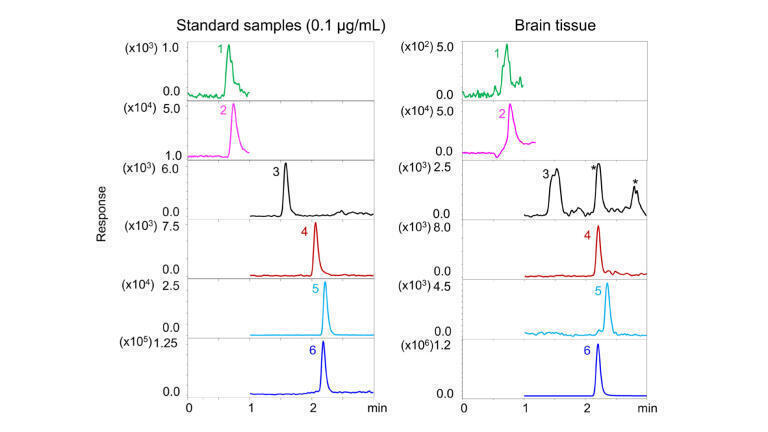
For the application of the method to a biological matrix, teleost brain tissue was extracted with 1 mL methanol. Centrifugation removed protein components from the sample. The resulting supernatant was evaporated and reconstituted in a 50:50 mixture of eluent A and B. Figure 3 demonstrates that all target compounds are reliably quantified in the biological sample.
The bioinert coated YMC Accura Triart C18 column enhances sensitivity and delivers sharper peak profiles for the analysis of tryptophan and its metabolites. This Application Note confirms the method’s suitability for complex biological matrices and demonstrates its robustness under real-world conditions.

 Product directory