Preparative
Published over 16 years ago. See the latest and most current information on Preparative.
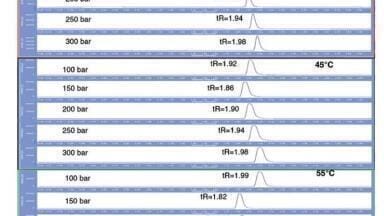
Developing simple and straightforward reversed phase chiral HPLC separations coupled with highly sensitive MS detection is highly needed for conducting drug metabolism and pharmacokinetic studies of stereoisomers in the drug development process. Polysaccharidebased chiral stationary phases (CSPs) are most prevalent in chiral LC due to their wide applicability and good selectivity. However, most chiral separations on polysaccharide CSPs are carried out under normal phase (NP) conditions with mobile phases (e.g. hexane/IPA) which may be incompatible with MS detection due to their high flammability in ion sources operated at high temperature. While separations conducted in polar organic (PO) mode utilize mobile phases that potentially prevent analyte ionization in the source, rendering them undetectable. The most promising separation mode for chiral LC/MS analysis is reversed phase (RP) LC. Moreover this separation mode is also complementary in selectivity to NP and PO separation modes (with either MS or UV detection).
 Product directory