HPLC, UHPLC
Published over 15 years ago. See the latest and most current information on HPLC, UHPLC.
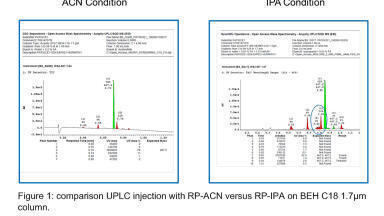
Many liquid chromatography methods are developed using organic mobile phase additives which allow compatibility with mass-spectrometric (MS) detection. However, these types of additives often give high UV absorbance which can lead to low level impurity quantitation issues.
Additionally, these additives often have little or no buffering capacity at the pH they are typically used, which in turn can lead to variability in analyte retention time. A rational approach for the selection of phosphate buffers from organic based mobile phase additives of the same pH (acidic or neutral) in liquid chromatography stability indicating method (SIM) development may provide a solution to this problem. Excellent correlation was observed for analyte retention (33 test analytes) in switching from an organic based mobile phase additive to an appropriate potassium phosphate buffer at low and mid pH. This approach provides a basis for developing SIM methods under mass-spectrometer friendly conditions and converting them directly to phosphate methods (or vice-versa) which typically provide higher UV sensitivity and retention robustness while maintaining the elution order and chromatographic resolution observed with the organic mobile phase additives.
Keywords: UHPLC, phosphate buffers, retention correlation, ion-pairing




 Product directory