Preparative
Published over 16 years ago. See the latest and most current information on Preparative.
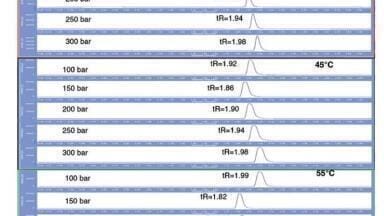
This article discusses the use of high temperature water as a mobile phase and in particular to its application with sub 2 micron phases. A model is discussed which allows for the characterisation of the experimental conditions and is used later to determine the conditions required for an isobaric thermal gradient to be operated. The use of isothermal and thermal gradients are discussed and some example separations are given.
Introduction
Water at room temperature is not commonly used as an elution solvent in reversed phase liquid chromatography, primarily because it does not elute most hydrophobic compounds. As a result organic solvents, such as methanol and acetonitrile, are routinely used to elute hydrophobic compounds from a hydrophobic stationary phase, either isocratically or by using a gradient. These solvents also have the advantage that they possess lower viscosity than water and as a result lower the operating pressure of the HPLC system. This has become of particular importance in recent years, with the advent of sub 2 micron particles.

 Product directory