Bioanalytical
Published over 5 years ago. See the latest and most current information on Bioanalytical.
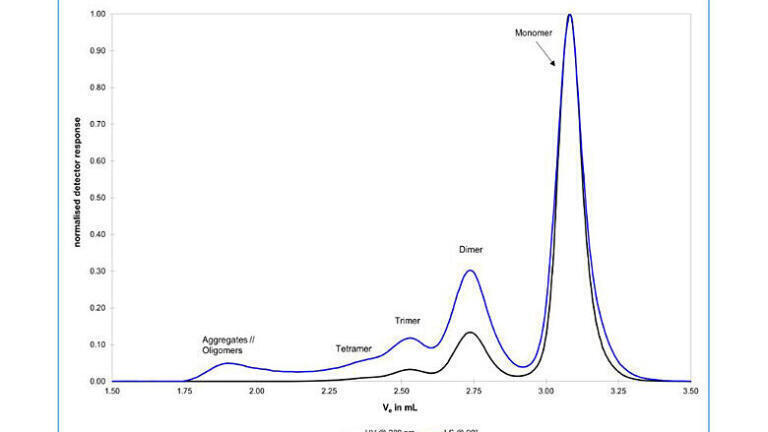
Size exclusion chromatography (SEC) is not only used to separate compounds according to molar mass (MW) but also to gain information on the relative distribution of the MW of a sample.
In combination with light scattering detection, SEC delivers absolute molar mass data for the characterisation of macromolecules such as proteins and antibodies. The greatest advantage is that there is no need for column calibration. Further, the signal intensity directly depends on the molar mass, injected mass and refractive index increment squared. This results in high signal intensities for higher MW materials, such as larger aggregates, which provides increased sensitivities which cannot be obtained by using a concentration detector (e.g. UV, RI). In contrast, light scattering (LS) is a technique that is suitable to generate absolute molar mass data for the characterisation of macromolecules such as proteins or antibodies.
In order to combine SEC with MALLS, the SEC column has to be compatible with LS detection. Therefore, very high column purity is required to prevent spikes in the chromatogram caused by particles from the column itself. Such spikes cannot be seen in UV or RI detection.
YMC offers different SEC columns, with several pore and particle sizes. YMC-Pack Diol columns are available with 60 Å, 120 Å, 200 Å and 300 Å and with 3 μm and 5 μm for HPLC, while 2 μm columns for UHPLC proposes are available in combination with the 200 Å and 300 Å pore sizes. YMC-SEC MAB columns which are dedicated for monomer, fragment and aggregate analysis of antibodies are available with 250 Å and 3 μm particles.
All YMC SEC columns show a high compatibility with MALLS detection using typical eluents in BioLC such as phosphate buffers, as their noise levels are very low as required for such detection modes as shown and explained in detail in a Technical Note.
 Product directory