Mining the highly complex human intestinal metaproteome may be more effective using
liquid chromatography-mass spectrometry (LC-MS), according to scientists.
A team from the Netherlands' Wageningen University, the University of Helsinki and the French agricultural research group INRA share their findings in BMC Genomics.
They explain how the intestinal tract presents significant complexity during analysis, with more than 5,000 species of bacteria apparent in humans.
As a result, the number of genes that may appear in analysis is 100 times that contained within the human genome itself.
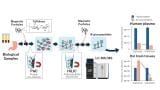
Using LC-MS and an iterative workflow, the researchers compared the results to known metagenomic data for two separate human faecal samples.
They found the number of identified spectra increased twofold using their method, while the false discovery rate associated with the experiment was no greater than around one per cent.
BMC Genomics disseminates research relating to all aspects of proteomics, functional genomics and analysis at the genome level.





 Product directory