Gas chromatography
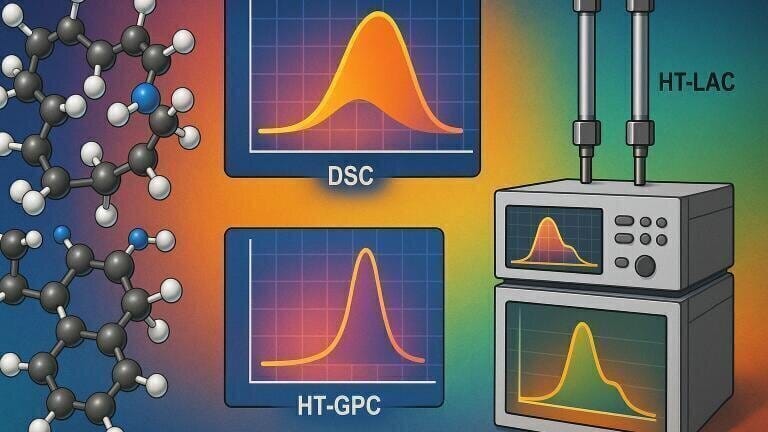
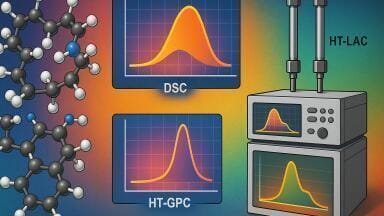
Ethylene/1-olefin copolymers have held industrial significance for a considerable period. A series of copolymers with identical molar mass and varying 1-hexene levels were synthesized using supported metallocene catalyst. Various analytical techniques were used to characterize the copolymers, focusing on the effect of increasing 1-hexene content on their chemical properties, specifically chemical composition distribution (CCD). Initially, the investigations carried out by differential scanning calorimetry (DSC) revealed broad and asymmetric thermograms with the presence of a distinct shoulder in samples with higher 1-hexene content. Furthermore, HT-GPC with IR5 detector revealed uniform chemical composition (1-hexene concentration) along the molar mass axis. Examination of the chemical composition distribution (CCD) was conducted using two variants of high-temperature liquid adsorption chromatography (HT-LAC), namely solvent gradient interaction chromatography (SGIC) and thermal gradient interaction chromatography (TGIC). Initial testing by employing solvents common to HT-LAC showed that the elution behavior did not correspond with the distinct thermal properties DSC. In the next step, new desorption-promoting solvents were identified using a recent approach that integrates structure retention relationships (SRR), a measure of solvent–stationary phase interactions, with Hansen solubility parameters (HSP), assessing polymer–solvent interactions. The broad and asymmetric CCD in samples with higher SCB, characterized by a main peak and a shoulder, was confirmed by SGIC using newly identified desorption-promoting solvents identified via the SRR–HSP method. This CCD profile was also corroborated by TGIC using a binary solvent mixture as the mobile phase.
To read the complete article click here:

 Product directory



















.jpg)