Liquid chromatography
Plasmid DNA (pDNA) is a small, circular DNA molecule found in bacteria. Unlike chromosomal DNA, it replicates independently. These unique properties make pDNA an indispensable tool in biotechnology and pharmaceutical research. To meet the growing demand in these fields, large quantities of pDNA are required. However, not all isoforms are equally functional. Open circular and linear forms often result from mechanical or chemical stress and are significantly less effective. Achieving high purity and isoform integrity is therefore not optional. It’s essential. Choosing the right ion exchange (IEX) resin plays a critical role in this process. Resins with high flow capacity and strong isoform selectivity not only improve recovery of the supercoiled form but also reduce processing times and simplify downstream analytics.
While IEX is an established method for pDNA purification, conventional IEX resins often reach their limits when applied to large biomolecules such as plasmids. One of the main challenges lies in the molecular size of pDNA, which can range from several kilobases (kb) up to over 20 kb – resulting in large, supercoiled structures with a substantial hydrodynamic radius.
Traditional IEX resins typically have pore sizes optimised for proteins or small nucleic acids. These small pores are often insufficient to allow pDNA to penetrate the resin matrix and access the internal functional ion exchange groups. As a result, the interaction between pDNA and the stationary phase is limited to the outer surface of the resin particles. In contrast, an IEX resin with a macro-porous structure offers a substantial advantage. Its larger pore allows even large plasmid molecules to diffuse into the inner structure of the resin beads and interact effectively with the functional groups. This increases dynamic binding capacity and facilitates isoform-selective purification. The result is a more efficient and scalable purification process that yields high-purity pDNA.
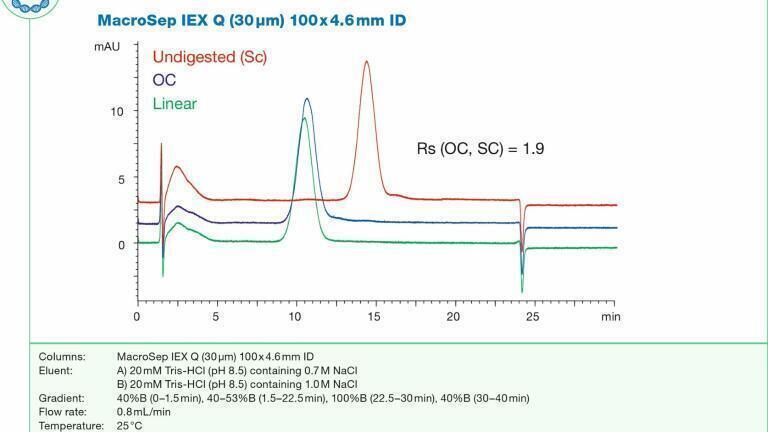
In one example, two different resins were evaluated for the purification of a model plasmid (pUC19, 2.7 kb). The results clearly demonstrate that MacroSep IEX Q enables efficient isolation of the supercoiled pDNA.
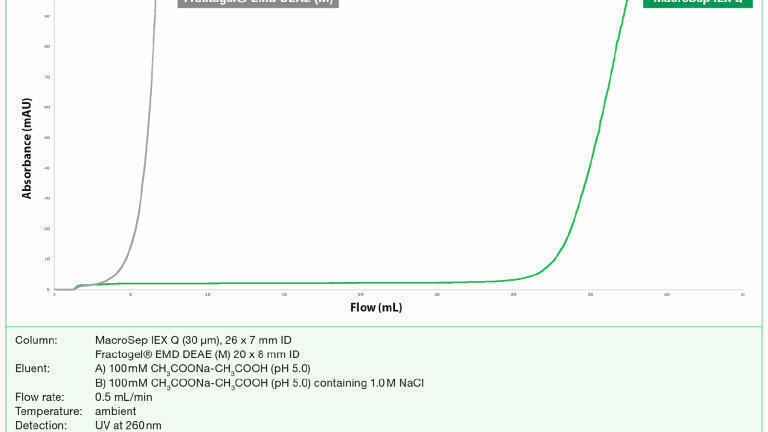
The breakthrough curves of two different process resins for a plasmid with a size of 4.9 kb are measured. Due to its size, resins with a standard pore size are unsuitable for purification of pDNA. This is also shown by the results: MacroSep IEX Q shows a later breakthrough of the pDNA compared to the alternative material exhibiting a pore size of about 80 nm. Therefore, the resin from YMC enables a significantly higher loading and thus contributes to a higher productivity of the overall process.
With its innovative design and demonstrated performance, MacroSep IEX Q represents a robust tool for the purification of plasmids. By addressing key priorities such as resolution, and process productivity, this resin offers a practical solution for optimising downstream processes. Discover more in the latest Application Note from YMC.

 Product directory