![Figure 2: Chromatograms obtained at different temperatures of (a) 40, (b) 60, (c) 70, and (d) 80 °C (pink). After every injection a blank run was performed (black) [1].](/assets/file_store/pr_files/65780/thumbnails/images/768w-432h-t-fit-250916_eBulletin_POC_Fig2.jpg)
![Figure 3: Analysis under optimised conditions of the crude POC (pink), the unmodified oligonucleotide (brown) and the modified oligonucleotide (orange) [1].](/assets/file_store/pr_files/65780/thumbnails/images/768w-432h-t-fit-250916_eBulletin_POC_Fig3.jpg)
Columns (LC)
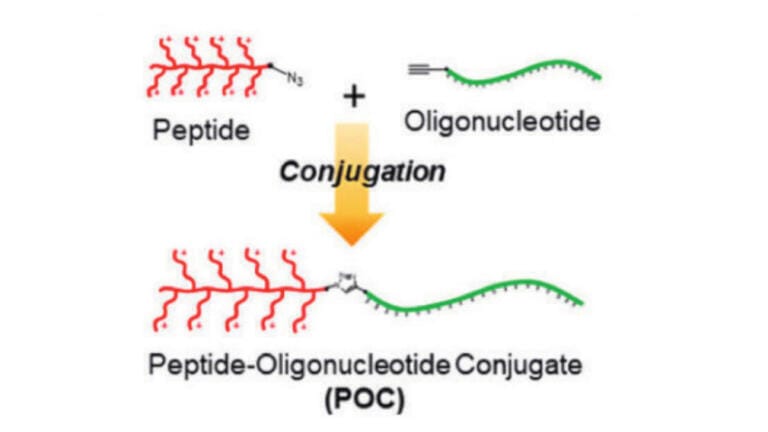
Peptide-oligonucleotide conjugates (POCs) provide an improved intracellular delivery, leading to an enhanced therapeutical potential of therapeutic oligonucleotides. Most established synthesis workflows rely on postsynthetic coupling with separate preparation steps for oligonucleotides and peptides. Exact differentiation of structurally similar impurities remains technically demanding and requires analytical precision.
This Application Note presents an optimised IP-RP method for a model POC, providing a reliable foundation for quality control workflows. The model POC is using a 21mer DNA sequence conjugated to a nonaarginine peptide conjugated through a click reaction.
In a first step a mobile phase screening using different ion-pairing agents was performed. TEA/HFIP and DEAA failed to deliver stable results under the given conditions. TEAA produced reproducible chromatograms with satisfactory peak shape. The most promising results were provided by BAA (not shown).
The initial screening gradient (0–50% B in 5min) was systematically optimised to enhance peak resolution. A shallow gradient from 7% to 17% acetonitrile over 10 minutes delivered the most effective separation of main and minor components. The pH value of the mobile phase was screened at pH 6.0, 7.0, and 8.0 to assess its influence on separation performance. Optimal results were achieved at pH 7.0, which delivered sharp peak resolution and minimal carry-over, establishing it as the preferred condition (not shown).
A temperature screening (40-80°C, Figure 2) showed that increasing the column temperature leads to sharper peaks. At 60°C, the main peak remained broad, while the peaks became sharper at 70°C. 80°C was chosen as optimal temperature because the peaks are sharp and minor peaks can be separated. No elution was observed at 40°C, although a minor UV increase between 7 and 9 minutes indicated partial interaction.
A wide-pore YMC Accura Triart Bio C18 column (30 nm) was used for prior investigations, because this column is known for its suitability in oligonucleotide analysis. To assess potential alternatives, YMC Accura Triart Bio C4 (30 nm pore) and YMC Accura Triart C18 (12 nm pore) columns were also tested under the already optimised conditions. All columns were equipped with the bioinert YMC Accura coating to mitigate interactions with metal surfaces. A more hydrophobic stationary phase is beneficial for the resolution, simultaneously a larger pore of 30 nm is required to achieve optimum recovery and low carry-over. This screening confirms YMC Accura Triart Bio C18 as ideal column for the analysis of the POC (not shown).
Under optimised conditions using a wide pore YMC Accura Triart Bio C18 with a BAA/acetonitrile eluent system, the method enables full separation of modified and unmodified oligonucleotides alongside the POC (Figure 3). All analytes elute with sharp peaks, delivering high resolution and analytical reliability suited for demanding quality control workflows.
Find all details of the method development in the Application Note.
[1] ACS Omega 2025, 10, 20, 20578-20584

 Product directory


















.jpg)
.jpg)