Liquid chromatography
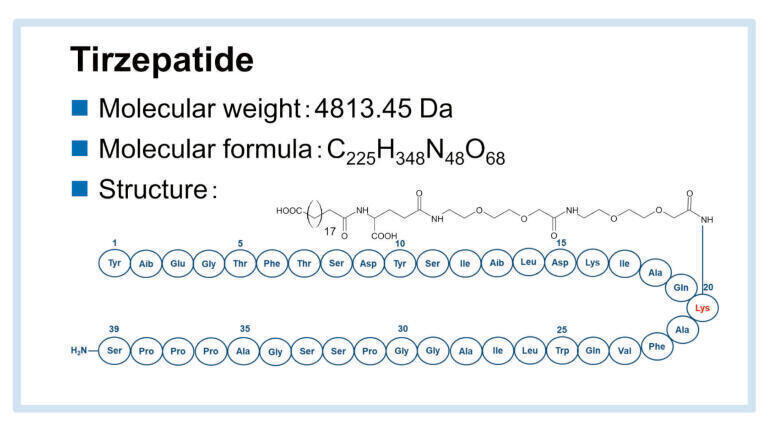
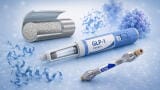
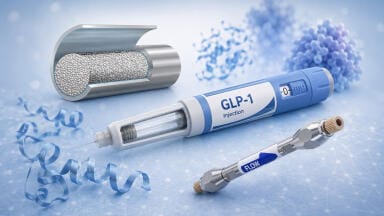
Tirzepatide acts as glucagon-like peptide-1 (GLP-1) and glucose-dependent insulinotropic peptide (GIP) receptor agonist, making it an effective treatment of type 2 diabetes with hypoglycemic and weight-loss effects. Due to their clinical value and pharmacological reliability, GLP-1 receptor agonists occupy a firm position in the global pharmaceutical landscape. Therefore, accurate quality control is essential, especially as the amino acid sequence and higher order structure have a significant impact on the therapeutic performance.
This Application Note outlines a structured method development for the analysis of tirzepatide. The screening protocol evaluates pH and organic modifier in the mobile phase, column temperature, stationary phase chemistry and the impact of bioinert column hardware.
As a first step a YMC-Triart C18 column is used to investigate aqueous eluents of different pHs of 2.0 – 2.5 – 6.7 – 8.0 (0.1% trifluoroacetic acid, 0.1% formic acid, 20 mM ammonium acetate, and 50 mM ammonium bicarbonate) in combination with acetonitrile or methanol. The column temperature is set to 40°C for the pH screening. Acetonitrile achieves sharper peak profiles across all tested conditions. Using a neutral to weakly alkaline mobile phase results in an improved resolution und sharper peaks compared to the lower pH mobile phases. The good solubility of tirzepatide in alkaline solutions can be one possible reason for this. Both, ammonium acetate and ammonium bicarbonate provide high resolution and are considered for further testing.
Raising the column temperature from 40°C to 60°C increases resolution. This observation is based on ammonium acetate eluent only, as ammonium bicarbonate’s volatility restricts its application at higher temperatures.
Three columns matching the general requirements of the peptide are compared: YMC-Triart C18 with 12 nm pores, YMC-Triart C8 with reduced chain length, and YMC-Triar Bio C18 featuring a 30 nm pore size. The comparison shows that the larger pore size of the YMC-Triart Bio C18 column is beneficial for the shape of the tirzepatide peak, achieving better separation from the later impurity peak. In combination with ammonium acetate, it provides significantly better resolution und a narrow peak width.
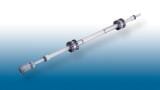
A comparison of bioinert coated column hardware with stainless-steel hardware at different sample concentrations shows that with the bioinert coated YMC Accura column higher peak areas and improved peak symmetry can be obtained. It is assumed that non-specific adsorption occurs on the surface of the stainless-steel column.
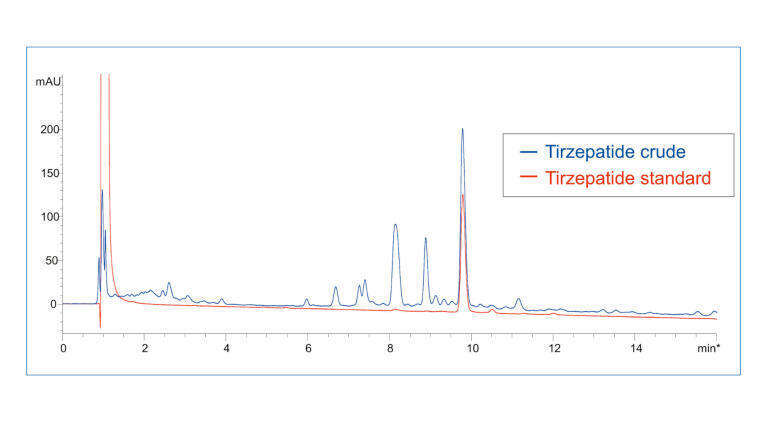
Additional adjustments of the gradient slope und organic solvent ratios resulted in a gradient of 36-44 %B in 16 min (Figure 3). This method establishes a robust and precise analytical workflow for purity testing of tirzepatide. Neutral to weakly alkaline conditions at elevated temperatures provide high resolution and sharp peaks. Furthermore, using the bioinert coated YMC Accura Triart Bio C18 column improves the peak shape and recovery, even for small sample volumes. This screening protocol supports method development for other GLP-1 receptor agonists and meets the demands of regulated pharmaceutical analysis.



 Product directory

















.jpg)