Liquid chromatography
Hydrophilic interaction liquid chromatography (HILIC) is increasingly recognised as a powerful alternative to ion-pair reversed-phase (IP-RP) and anion exchange (AEX) chromatography for the analysis of oligonucleotides. This Technical Note demonstrates how an optimised HILIC approach using bioinert coated YMC-Accura Triart Diol-HILIC columns enables robust separations, high sensitivity and excellent peak shapes for DNA, RNA and modified phosphorothioate RNA oligonucleotides - without the need for ion-pair reagents.
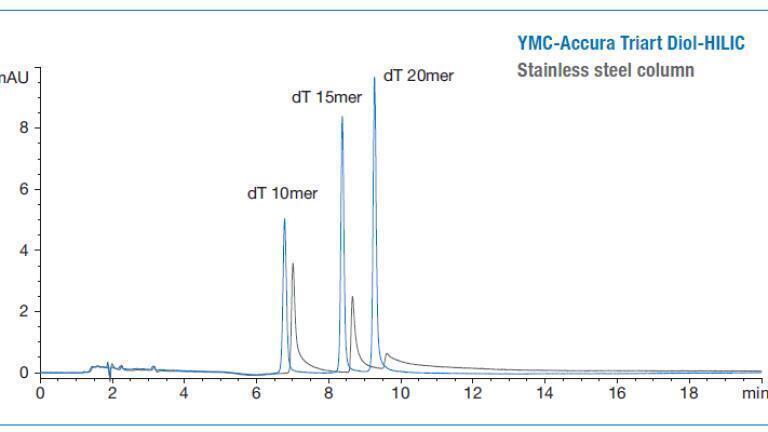
Oligonucleotides are highly polar and possess an electron-rich backbone, which can lead to strong interactions with metallic surfaces. These interactions often result in irreversible adsorption, distorted peak shapes and loss of sensitivity. The results presented in this Technical Note clearly demonstrate that bioinert column hardware effectively mitigates these effects. Compared with conventional stainless-steel columns, the bioinert coated YMC-Accura Triart Diol-HILIC columns provide markedly sharper peaks, higher signal intensity and significantly improved recovery, ensuring reliable and reproducible analytical performance.
The composition of the sample solvent has a pronounced impact on chromatographic performance, particularly for early-eluting oligonucleotides. As HILIC relies on a high organic content, DNA samples prepared in a high-organic solvent (80% acetonitrile) produce clean, sharp and highly sensitive peaks. In contrast, samples prepared with low organic content (30% acetonitrile) show pronounced peak broadening, peak splitting, increased injection peaks and additional early-eluting artefacts. These findings highlight that even a simple adjustment of the sample solvent composition can immediately and significantly improve data quality and method robustness.
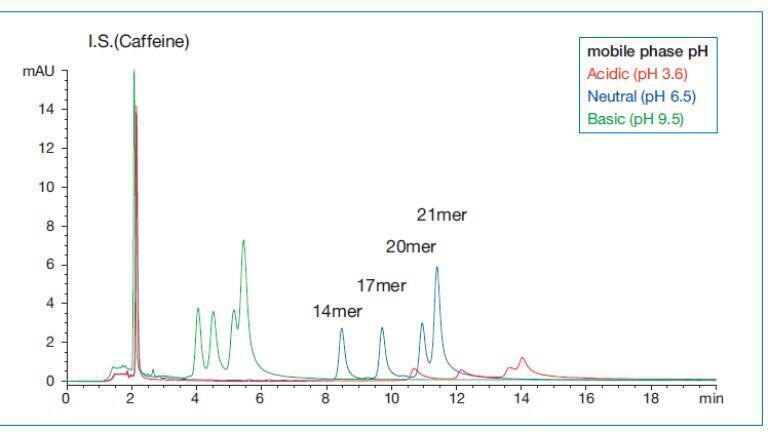
In HILIC, mobile phase pH has a pronounced influence on chromatographic retention and peak shape. Acidic conditions increase retention but also promote analyte adsorption, resulting in substantial signal loss, particularly for shorter RNA oligonucleotides. Under basic conditions, retention is reduced; however, this is accompanied by a decrease in chromatographic resolution. Overall, optimal performance is achieved at neutral to basic mobile phase pH, providing the most favourable balance between retention, resolution and recovery for the phosphodiester RNA oligonucleotide mixtures investigated.
The influence of column temperature on chromatographic performance was evaluated systematically. Variation of the column temperature between 40 and 60 °C resulted in only minor changes in analyte retention and showed no adverse effects on peak shape or chromatographic resolution for both phosphodiester and phosphorothioate RNA oligonucleotides.
This Technical Note demonstrates the excellent suitability of YMC Triart Diol-HILIC columns, particularly with bioinert coated YMC Accura hardware, for the robust and sensitive ion-pair free analysis of oligonucleotides using HILIC. The bioinert columns effectively prevent adsorption to metallic surfaces, delivering superior peak shape, higher recovery, and increased sensitivity compared to conventional stainless-steel hardware.
The results further show that small, targeted adjustments to key method parameters, such as sample solvent composition and mobile phase pH, can significantly enhance chromatographic performance.

 Product directory












.jpg)