HPLC, UHPLC
Published over 12 years ago. See the latest and most current information on HPLC, UHPLC.
Peak splitting is when a Gaussian peak gets a shoulder or a twin. They have the same base, are unexpected and can be caused by a number of factors. The splitting can affect all peaks or just one, and different effects can be attributed to different causes.
It is not always an instrument problem that causes peak splitting. Samples and sample preparation are also contributory factors as determinants of the degree of peak splitting.
If only one peak in a chromatogram is splitting or has a shoulder, the problem is likely to be something related to the separation. One way of checking this is to inject a smaller sample volume. If this results in two discernible peaks, the problem could be two components eluting close together.
In this case the separation resolution needs to be improved. This can be achieved by revisiting the method parameters such as mobile phase, temperature, flow rate or even column type.
If all of the peaks are split in an HPLC run, it is an indication of a problem happening before separation has taken place. There are two common causes for splitting of all the peaks namely:
A blocked frit causes a spreading out of the sample as it enters the column. Normally the sample flows through the frit in a parallel band. But if there is a blockage in the frit, then part of the sample is delayed and enters the column later.
Since the delivery of the sample to the column is spread out, the separation of the sample is spread out. Hence the peaks for each component are split, and all peaks in the chromatogram are split.
If there is a void in the packing material, some of the sample travels faster to the column. The effect is the same as with a blocked frit. The sample is spread out before it enters the column and all of the peaks in the chromatogram are split.
As with all analytical instrumentation problem solving, it pays to approach the issues in a systematic way.
Check the easy fixes first.
If there is contamination on the guard or analytical column inlet
Another possibility is that the sample solvent may be incompatible with the mobile phase. If so, change the solvent and whenever possible, inject samples in the mobile phase.
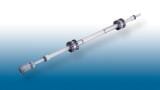
Prevention is better than cure. Using in-line filters and column guards can reduce the incidence of blockages in a chromatography system, so preventing peak problems. The problem of blocked frits is highlighted in: ACE Ultra Low Dispersion, High Quality UHPLC and HPLC Pre-column Filters.
Sample filtration should also be considered when there is a risk of insoluble material entering the system. Simple techniques can save many hours of troubleshooting and downtime.




 Product directory