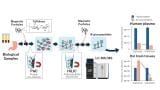
Metastatic pancreatic cancer cells - which have spread from elsewhere in the body - significantly differ from those which develop in the organ itself, analysis with
liquid chromatography and tandem mass spectrometry (LC-MS) reveals.
Scientists at the University of California, Los Angeles applied LC-MS to the analysis of membrane proteomes found in primary and metastatic pancreatic cancer cells.
They found 109 proteins that were present in both cell lines, indicating some similarities between the two.
However, in total they detected 221 proteins in metastatic AsPC-1 cells and 208 proteins in primary BxPC-3 cells.
With almost half of all the proteins identified appearing only in one cell type, the researchers conclude that metastatic and primary cells differ significantly.
As a result, they suggest targeting the differentially expressed proteins in the cell membranes with therapeutic or diagnostic interventions in the future.
The Journal of Biomedical Science is edited by Michael M C Lai of National Cheng Kung University and supported by the National Science Council of Taiwan.





 Product directory