HPLC, UHPLC
Objective
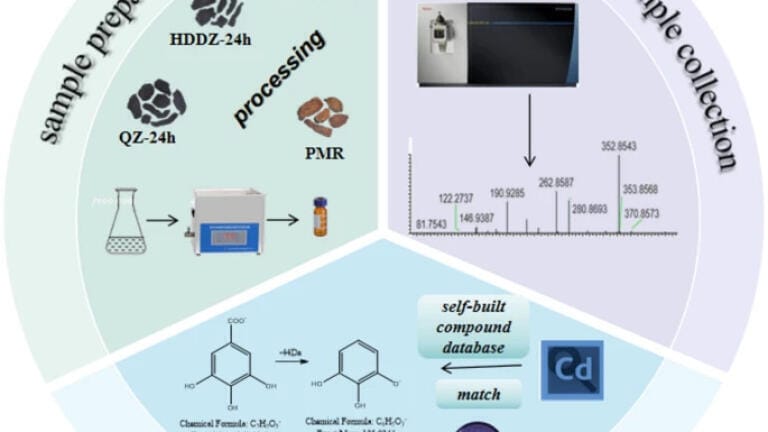
To rapidly characterize the chemical constituents of Polygoni Multiflori Radix and its processed form, Polygoni Multiflori Radix Preparata, utilizing ultra-high performance liquid chromatography coupled with quadrupole-orbitrap-linear ion trap high-resolution mass spectrometry (UHPLC-Q-Orbitrap-Linear Ion Trap-MS).
Methods
Chromatographic separation was achieved on an ACQUITY UPLC BEH phenyl column (1.7 μm, 2.1 × 100 mm) employing a gradient elution of methanol (A) and 0.1% formic acid aqueous solution (B). Mass spectrometric analysis was conducted using a heated electrospray ionization (H-ESI) source operated in negative ion mode. Data processing was performed using Thermo Scientific Compound Discoverer 3.0 software, integrating a self-constructed Polygoni Multiflori Radix MS and MS/MS spectral database. Compounds with a mass error tolerance of ≤ |5| ppm were tentatively identified via freestyle software and further validated by comparison with previously reported literature data.
Results
A total of 231 chemical constituents were tentatively identified through online analysis, comprising 64 stilbene glycosides, 28 anthraquinones, 38 flavonoids, 45 polyphenols, 18 amino acids, 7 naphthalenes, 6 chromones, 3 alkaloids, 5 fatty acids, and 17 other components. Following 24 h of processing, the levels of stilbene glycosides, free anthraquinones, torachrysone, and torachrysone-8-O-β-D-glucoside were observed to decrease, while the concentrations of dianthrones and bound anthraquinones exhibited a significant reduction. In contrast, the content of gallic acid increased markedly.
Conclusions
These findings provide a robust scientific foundation for further exploration of the active and toxic components in Polygoni Multiflori Radix and its processed form, Polygoni Multiflori Radix Preparata, contributing to a deeper understanding of their pharmacological and toxicological profiles.
Polygoni Multiflori Radix, derived from the dried tuberous roots of Polygonum multiflorum Thunb., is a traditional Chinese medicinal herb renowned for its bitter, sweet, and astringent taste, as well as its slightly warm properties. It is traditionally associated with the liver, heart, and kidney meridians and has been widely utilized for its detoxifying, anti-abscess, antimalarial, and laxative effects. The processed form of Polygoni Multiflori Radix, known as Polygoni Multiflori Radix Preparata, exhibits enhanced pharmacological activities, including tonifying the liver and kidneys, replenishing essence and blood, darkening hair, strengthening bones and tendons, and reducing turbid lipids [1]. However, with the expanding clinical application of Polygoni Multiflori Radix and Polygoni Multiflori Radix Preparata, increasing attention has been directed toward their potential hepatotoxicity. Studies have demonstrated that both Polygoni Multiflori Radix and its processed form may induce liver dysfunction and even drug-induced liver injury (DILI), raising significant concerns regarding their clinical safety and quality control [2, 3]. Given that the chemical constituents of Polygoni Multiflori Radix are the primary determinants of its pharmacological efficacy and toxicity, a comprehensive and systematic investigation into its chemical composition is of paramount importance.
Traditional Chinese Medicine (TCM) is characterized by its multi-component, multi-target, and multi-pathway nature, underpinned by a highly complex chemical composition [4]. In the analysis of TCM constituents, liquid chromatography-mass spectrometry (LC-MS) has demonstrated significant advantages, enabling the efficient detection and identification of trace components within complex matrices [5]. High-resolution mass spectrometry (HRMS), in particular, not only delivers precise molecular weight information but also generates extensive structural data through multi-stage mass spectrometry (MS/MS), facilitating the comprehensive characterization of chemical constituents [6]. Additionally, LC-MS requires minimal sample quantities and offers rapid analysis, effectively addressing challenges such as component loss or degradation often associated with traditional analytical methods. Consequently, LC-MS has emerged as a highly efficient, sensitive, and reliable analytical tool for the systematic investigation of chemical constituents in TCM [7].
In previous studies, our research team conducted a comprehensive chemical characterization of Polygoni Multiflori Radix, identifying a total of 152 compounds, including 50 anthraquinones, 33 stilbenes, 21 flavonoids, 7 naphthalenes, and 41 other compounds [8], utilizing a zebrafish model for toxicity evaluation, we further demonstrated that the toxicity of Polygoni Multiflori Radix could be reduced by more than 85% following pure steaming for 24 h, achieving the desired detoxification effect [9]. Given that the Chinese Pharmacopoeia (2020 edition) specifies three processing methods for Polygoni Multiflori Radix Preparata—stewing with black bean juice, steaming, and steaming with black bean juice—this study employed ultra-high-performance liquid chromatography coupled with quadrupole-orbitrap-linear ion trap mass spectrometry (UHPLC-Q-Orbitrap-Linear Ion Trap-MS) to systematically analyze the chemical profiles of Polygoni Multiflori Radix and Polygoni Multiflori Radix Preparata processed using these three methods. To comprehensively capture the diverse chemical constituents, extraction was performed using three solvents of varying polarities: water, 70% ethanol (v/v), and 95% ethanol (v/v). By constructing a chemical database for Polygoni Multiflori Radix Preparata and comparing the results with literature-reported compounds, we not only systematically tentatively identified the chemical constituents in Polygoni Multiflori Radix Preparata but also summarized the changes in the content of different types of compounds before and after processing. This study provides a robust scientific foundation for further research into the bioactive and toxic components of Polygoni Multiflori Radix and Polygoni Multiflori Radix Preparata, offering valuable insights for establishing quality standards and evaluating the quality of these medicinal materials. [Continued…]
To read the complete article click here:


 Product directory