HPLC, UHPLC
A rapid, accurate, sensitive, and eco-friendly micellar liquid chromatography method has been successfully developed and validated for the simultaneous determination of clindamycin and adapalene in their bulk forms and combined dosage gel formulations. The separation was performed on a BDS HYPERSIL C18 column (150 × 4.6 mm, 5 μm), employing a micellar mobile phase made up of 0.07 M sodium dodecyl sulfate, 0.3% triethylamine, 0.02 M orthophosphoric acid (pH adjusted to 3.0), and 14% isopropanol (v/v). Detection was carried out using UV at 210 nm. The method exhibited linearity in the ranges of 100–500 µg/mL for clindamycin phosphate and 10–50 µg/mL for adapalene, with detection limits of 13.4 µg/mL and 1.4 µg/mL, respectively. The developed method was effectively applied to the analysis of a laboratory-prepared co-formulated gel, yielding high recovery rates. The greenness of the method was further confirmed through assessment with the Green Analytical Procedure Index (GAPI). The method was also validated as a stability-indicating assay for clindamycin phosphate and adapalene under various stress conditions, demonstrating its robustness and applicability for routine quality control.
Acne vulgaris is a prevalent skin condition that affects around 85% of adolescents, though it may develop at any stage of life. It is an inflammatory disease of the pilosebaceous units and is often associated with psychosocial distress. Recently, new therapeutic combinations of topical formulations for acne treatment have been developed and now form the backbone of effective management strategies [1,2,3].
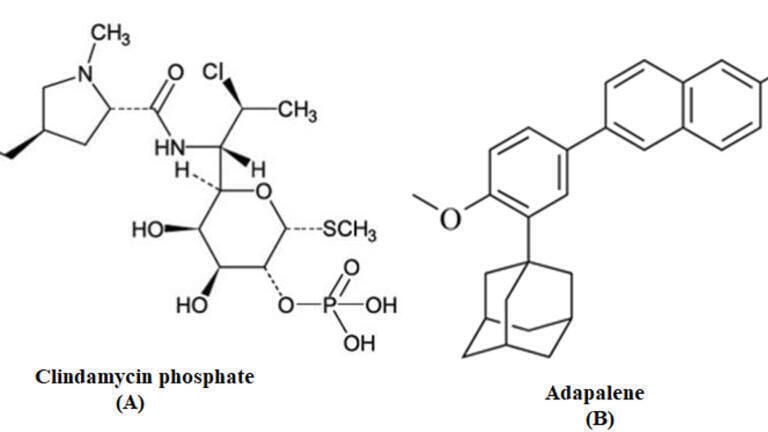
Among the various drugs available for acne treatment, clindamycin phosphate (CID) and adapalene (ADA) are frequently combined and applied topically to manage mild to moderate acne inflammation. Clindamycin phosphate (Fig. 1A) is a lincosamide antibacterial agent effective against Gram-positive aerobic bacteria as well as Gram-positive and Gram-negative anaerobes. When applied topically, CID has shown efficacy against Cutibacterium acnes [4, 5]. Adapalene (Fig. 1B) is a third-generation retinoid with improved efficacy and photostability compared to earlier generations. Retinoids possess anti-inflammatory properties and correct abnormal follicular keratinization [6, 7].
Several reversed-phase HPLC methods have been reported for the simultaneous determination of clindamycin phosphate and adapalene in topical gels [8,9,10]. However, these procedures typically employ large amounts of hazardous organic solvents (up to 50% acetonitrile) and/or gradient elution, which increasing cost, environmental burden, and operational complexity [11]. In contrast, micellar liquid chromatography (MLC) offers a greener and simpler alternative by using aqueous surfactant solutions with minimal organic modifier. The present work therefore introduces, optimizes, and validates a rapid, eco-friendly, isocratic MLC–UV assay requiring only 14% isopropanol. This assay demonstrates both environmental and practical advantages over existing methods and fulfilling the criteria of the Green Analytical Procedure Index (GAPI).
Micellar liquid chromatography (MLC) presents an environmentally friendly substitute for conventional reversed-phase liquid chromatography. It utilizes aqueous surfactant solutions at concentrations exceeding the critical micelle concentration, along with a minimal amount of organic solvent, to improve both elution strength and efficiency. MLC enables the separation of compounds with varied chemical properties using significantly less organic solvent and without the need for gradient elution [12,13,14].
This study introduces an eco-friendly and sensitive micellar liquid chromatography–UV technique for the simultaneous analysis of CID and ADA in a laboratory-prepared combined gel formulation. Unlike previously reported methods, this approach notably minimizes the use of organic solvents. The method was validated according to ICH guidelines [15], and chromatographic parameters were optimized to achieve effective separation. Additionally, the method was evaluated as a stability-indicating assay for CID and ADA under various stress conditions. Assessment of the method’s greenness was carried out using the GAPI tool [16].
To read the complete article click here:

 Product directory