HPLC, UHPLC
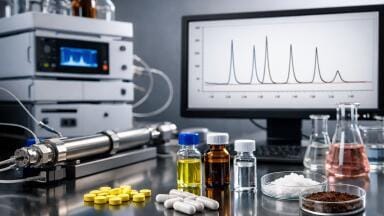
Researchers have shown that high-performance liquid chromatography can confirm purity, phase composition and component ratios in a solvent–antisolvent derived HMX/RDX composite
Researchers have reported the successful preparation and characterisation of a novel composite explosive based on octahydro-1,3,5,7-tetranitro-1,3,5,7-tetrazocine and hexahydro-1,3,5-trinitro-1,3,5-triazine, commonly referred to as HMX and RDX. Central to the study was the application of high-performance liquid chromatography (HPLC) which enabled quantitative verification of composite composition and provided analytical assurance of product purity following synthesis via a solvent–antisolvent alternating method.
HMX and RDX are widely regarded as benchmark monocomponent explosives because their detonation characteristics and thermal stability strongly influence both performance and safety in weapon systems. HMX exhibits an explosive heat of approximately 5,674 kJ per kilogram and a detonation velocity close to 9,109 metres per second, alongside high density and strong thermal stability. These attributes have supported its extensive use in polymer-bonded explosive formulations such as LX-14 and PBX 9404.
LX-14 is the designation for a plastic-bonded high explosive developed in the United States during the Cold War for military and nuclear-weapons applications.
In chemical terms, LX-14 consists primarily of HMX (cyclotetramethylene-tetranitramine), a powerful nitramine explosive, combined with a small percentage of a polymeric binder. The binder reduces brittleness and increases mechanical stability, which allows the explosive to be machined into precise shapes without cracking. That precision is essential in systems that rely on carefully controlled detonation geometry.
RDX offers a complementary profile, with a detonation velocity of approximately 8,750 metres per second and a detonation pressure of around 34 gigapascals, while delivering a detonation heat comparable to that of HMX at substantially lower material cost. This economic advantage has underpinned its widespread deployment in formulations including CH-6 and PBX 9407.
PBX 9404 and PBX 9407 are plastic-bonded high explosives (PBXs) developed in the United States during the Cold War, primarily for use in nuclear weapons. The term plastic-bonded explosive refers to a formulation in which energetic crystals are held together by a small amount of polymer binder. The binder improves mechanical strength and safety while preserving very high explosive performance.
PBX 9404 is a high-performance formulation based mainly on HMX (cyclotetramethylene-tetranitramine), with a small fraction of polymer binder and plasticiser. It was engineered to deliver extremely high detonation velocity and brisance, properties essential for driving the symmetric implosion required in many nuclear weapon designs. PBX 9404 was widely used in US nuclear warheads from the 1950s onwards, although it is relatively sensitive by modern standards.
PBX 9407 is closely related but was designed to be less sensitive to shock and mechanical insult. It replaces part of the HMX content with TATB (triaminotrinitrobenzene), an explosive notable for its exceptional insensitivity. The result is a formulation with slightly lower peak performance than PBX 9404 but much greater resistance to accidental detonation. PBX 9407 was adopted in later weapon designs as safety considerations began to carry more weight alongside raw explosive power.
The combination of HMX and RDX therefore represents a strategically important approach to balance performance, safety, and cost, provided that compositional control and interfacial integrity can be assured.
Earlier composite systems have relied predominantly on mechanical mixing, a process that often leads to weak interfacial bonding, heterogeneous distribution of components, and elevated crystal defect densities. These shortcomings can reduce detonation completeness and energy release efficiency while increasing sensitivity. Analytical techniques capable of resolving component ratios and detecting trace impurities are therefore essential when alternative preparation routes are pursued.
In the present study, HMX/RDX composites were synthesised with a distinct core – shell architecture in which HMX formed the core and RDX constituted the coating layer. HPLC was used to quantify the HMX-to-RDX ratio with high precision and to confirm the absence of residual solvents or unintended by-products. The chromatographic data demonstrated that the solvent–antisolvent alternating method yielded composites with tightly controlled composition and high chemical purity, providing a robust analytical foundation for subsequent structural and thermal analyses.
Optical microscopy supported these findings by confirming structural uniformity, while Fourier transform infrared spectroscopy and powder X-ray diffraction verified that HMX remained in its β-crystalline form within the composite.
For further reading please visit: 10.1038/s41598-026-37049-1

 Product directory