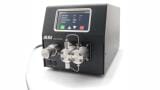
Scientists have used fast-protein
liquid chromatography (FPLC) to look for the ovulation-inducing factor present in llama seminal plasma.
Writing in Reproductive Biology and Endocrinology, they describe the process used, which saw semen collected from llamas and centrifuged to separate out the plasma.
This was separated into three protein fractions, labelled A, B and C, while FPLC was then applied to further split the last of the three into fractions C1 and C2.
A prominent, 14 kDa band of protein in the C fraction inspired this decision, with fraction C2 then used in the study.
The scientists write: "Ovulation-inducing factor was isolated from llama seminal plasma as a 14 kDa protein molecule that elicits a pre-ovulatory luteinising hormone surge, followed by ovulation."
Research was conducted by scientists from the Universidad Austral de Chile and the University of Saskatchewan, and features in the open-access journal of fertilisation, gestational biology and reproductive investigations.




 Product directory