GC-MS
ISO 16094-3 sets out how pyrolysis and thermal extraction desorption GC-MS identify microplastics by polymer type and quantify them by mass. It complements the particle counts of the spectroscopic Part 2.
A standardised gas chromatography-mass spectrometry (GC-MS) approach to microplastics in drinking water is at the final stage before publication. The International Organization for Standardization (ISO) lists ISO 16094-3 as a final draft.
Its full part title is “Thermo-analytical methods for waters with low content of suspended solids including drinking water”. ISO’s page places it at stage 50.00, meaning the final text has been received or the Final Draft International Standard (FDIS) registered for formal approval.
The document is being developed by ISO/TC 147/SC 2, the water quality subcommittee for physical, chemical and biochemical methods. It will be the first edition.
The European version, FprEN ISO 16094-3, sits with the European Committee for Standardization (CEN) water analysis committee, CEN/TC 230. A secondary catalogue listing records the formal vote closing on Tuesday, 10 November 2026 and gives an expected publication date of Wednesday, 10 February 2027.
The scope is narrow. Part 3 covers the determination of polymer types and the mass of microplastics in a sample. It does not cover particle size, particle shape or particle numbers.
The draft text put to enquiry in 2024 defines a microplastic as a solid plastic or synthetic polymer particle that is insoluble in water. Its largest dimension must lie between 1 µm and 5 mm. The final text may differ in detail from that enquiry draft.
The target matrices are drinking water and other waters with a low content of natural total suspended solids (TSS). The draft refers to ISO 6107 for that limit, giving 1–100 mg/l, or lower where suspended solids interfere.
The main polymers named in the draft are polyethylene (PE), polypropylene (PP), polyethylene terephthalate (PET) and polystyrene (PS). Depending on the method, polyvinyl chloride (PVC), polycarbonate (PC), poly(methyl methacrylate) (PMMA), polyamide (PA) and polyurethane (PU) may also be detected. Elastomers are excluded.
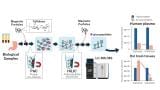
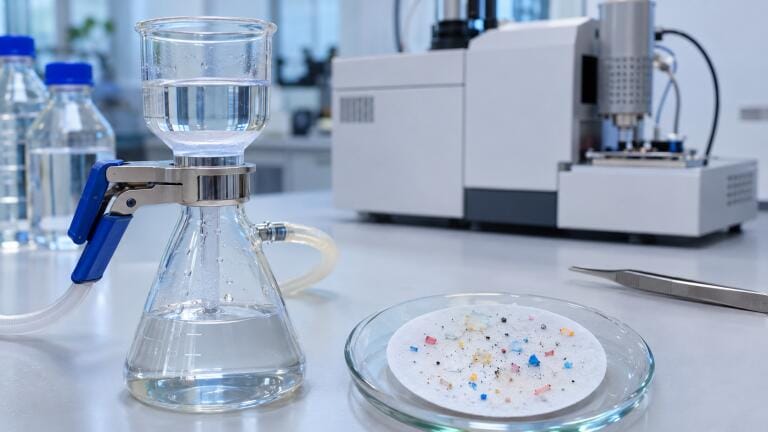
The draft describes three method set-ups. Thermal extraction desorption GC-MS (TED-GC-MS) is applied to filtration residues. Pyrolysis GC-MS (Py-GC-MS) is applied both to filtration residues and to isolated individual particles.
The shared principle is thermal decomposition. The draft defines pyrolysis as irreversible chemical decomposition caused by heating without oxidation. The decomposition products are separated chromatographically and identified by mass spectrometry, so polymer identity and mass are derived from chemistry rather than from optical or vibrational properties.
That distinction drives the different working ranges set out in the draft. For TED-GC-MS, the minimum measurable mass is given as 0.1–2 µg absolute, and the minimum particle size is listed as undefined. For Py-GC-MS, the minimum mass is 0.01–1 µg absolute, with particles selected by visual identification.
For method developers, the practical consequence is that polymer mass on the filter, rather than particle count, becomes the limiting variable. Calibration, quantification and cleaning protocols each have dedicated clauses in the draft.
Published performance evidence comes from an interlaboratory comparison run under the Versailles Project on Advanced Materials and Standards (VAMAS). It was led by Germany’s Federal Institute for Materials Research and Testing (BAM) and published in Analytical Chemistry in April 2025.
Of 84 registered laboratories, 56 reported results. Participants received tablets containing PET or weathered PE powder in a polyethylene glycol and lactose matrix, with additional pure polymer supplied for calibration.
For the thermo-analytical methods, reproducibility ranged from 62 to 117 per cent for PE and from 45.9 to 62 per cent for PET. The equivalent figures for the spectroscopic methods were 121 and 129 per cent for PE, and 64 and 70 per cent for PET.
The two thermo-analytical techniques agreed closely on mass. Mean PET results were 1.69 µg/mg by TED-GC-MS and 1.67 µg/mg by Py-GC-MS. For aged PE, the means were 1.14 µg/mg and 1.11 µg/mg respectively.
The study also identifies where thermo-analytical uncertainty arises. Many participants reported detector saturation when measuring PET, and some responded by cutting filters into pieces or increasing the injector split ratio.
The authors judged instrument calibration to be a relatively small contributor to uncertainty. Losses during filtration, by contrast, appeared unavoidable, and dissolving the tablets proved difficult enough that the authors recommended optimising that step.
Contamination control remains a live issue. The blank tablets contained small amounts of PE and PET along with other polymers. Background contamination data from individual laboratories were not collected.
The authors stated that the results would be passed to ISO/TC 147/SC 2 to support the development of ISO 16094-2 and ISO 16094-3.
The sibling standard, ISO 16094-2:2025, was published in September 2025. It covers vibrational spectroscopy methods, coupling microscopy with spectroscopic identification for the same low-suspended-solids waters.
Part 2 addresses what Part 3 excludes. It counts particles, determines their size and sorts them into size classes across a stated range of 1 µm to 5,000 µm, identifying ten main polymers.
The two parts therefore answer different questions of the same sample. Spectroscopy reports how many particles are present and how large they are. Thermo-analytical GC-MS reports how much polymer, by mass, is present for each polymer type.
In the EU, Commission Delegated Decision (EU) 2024/1441 supplements the Drinking Water Directive, Directive (EU) 2020/2184, with a methodology for measuring microplastics in water intended for human consumption.
The Decision was adopted on Monday, 11 March 2024 and entered into force on Friday, 17 May 2024. Its methodology is based on infrared and Raman microspectroscopy of particles.
Part 3 does not change that framework. It does, however, give laboratories a standardised GC-MS route to mass-based polymer data that can sit alongside spectroscopic particle counts.
 Product directory