GC-MS
A splitless liquid injection method with standard-addition calibration quantified alcohols, esters and acids in wines and an apricot spirit after filtration alone. Headspace extraction still detected trace terpenoids that the direct method could not.
Researchers at Laimburg Research Centre, in the Italian province of Bolzano, have optimised a direct liquid injection method for wines and spirits. It uses gas chromatography–mass spectrometry (GC-MS) to quantify selected volatile organic compounds (VOCs). They also compared its detectability with headspace solid-phase microextraction (HS-SPME) GC-MS on the same wine.
The paper, by Martina Moretton, Peter Robatscher and corresponding author Daniela A. Hey, was published online in Food Analytical Methods on Thursday, 19 November 2026. It is open access.
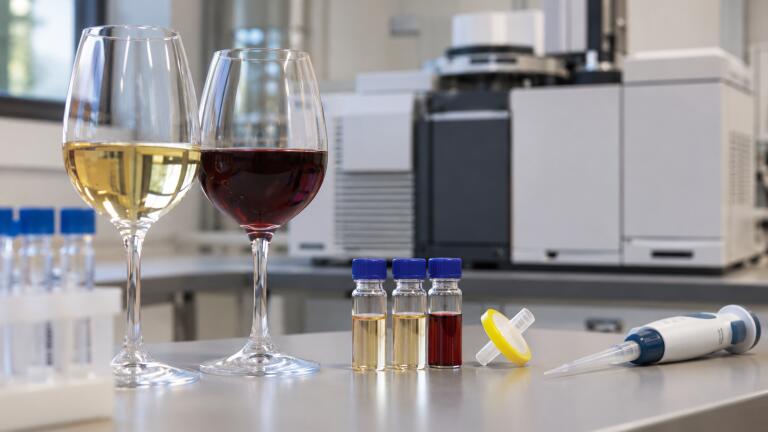
The main practical draw is sample preparation. Each sample was passed through a 0.2 µm regenerated cellulose syringe filter. A 990 µL aliquot then went into a 2 mL vial with 10 µL of acetophenone-d8 as internal standard. There was no extraction or preconcentration step.
The method targeted ten VOCs: isoamyl alcohol, hexan-1-ol, trans-rose oxide, linalool, α-terpineol, ethyl lactate, diethyl succinate, 2-phenylethanol, octanoic acid and decanoic acid. The list covers higher alcohols, esters, medium-chain fatty acids and terpenoids.
Separation used a Zebron WAX PLUS column (60 m × 0.25 mm × 0.25 µm) with a 10 m integrated guard column, on a Shimadzu QP2010-SE. Helium carrier gas ran at a constant linear velocity of 28.1 cm/s.
Detection used electron ionisation at 70 eV in selected ion monitoring (SIM) and full-scan modes. Each compound was identified by retention time plus one quantifier and two qualifier ions.
The team compared 15 GC methods on a Pinot Noir. They varied splitless time, injector temperature, injection volume, split ratio, oven ramp, solvent cut time and initial oven temperature.
Lengthening the splitless time across 0.6–1.5 min increased responses for most compounds. An injector temperature of 250 °C gave better responses than 200 °C.
Raising the injection volume to 5 µL markedly reduced the response of most compounds. Switching to split injection at 2:1, 5:1 or 10:1 drastically reduced signal intensity. A starting oven temperature of 40 °C gave better focusing than 60 °C.
The selected conditions were designated method 6. These comprised a 1 µL splitless injection at 250 °C, a 1.5 min splitless time and an initial oven temperature of 40 °C.
Quantification relied on standard addition in each native sample rather than external calibration. The workflow follows a 2017 procedure from the EU Reference Laboratory for Pesticides (EURL).
Each analytical batch comprised 15 calibration samples, with water/ethanol (85:15) blanks separating triplicate sets. Precision was assessed with three replicates on three separate days.
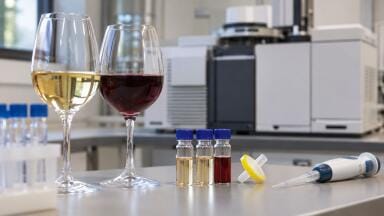
The method was then applied to four wines and one spirit, each analysed in triplicate. The wines were a Sauvignon Blanc (2022), Gewürztraminer (2021), Pinot Noir (2022) and Lagrein (2013). The spirit was an apricot spirit produced in 2025.
Isoamyl alcohol was quantified in every sample and was much higher in the spirit. Diethyl succinate was quantified in all four wines but was not detected in the spirit. 2-Phenylethanol appeared in all the wines but fell below detection in the spirit.
Ethyl lactate was highest in the Gewürztraminer. Octanoic acid was high in the Sauvignon Blanc and Lagrein but below detection in the Pinot Noir and the spirit.
Terpenoids were the weak point. During optimisation on the Pinot Noir, trans-rose oxide and linalool remained undetected.
Across the sample set, linalool was quantified only in the apricot spirit. α-Terpineol gave a trace signal below its limit of detection, and trans-rose oxide was not detected. The authors concluded that the method lacked sufficient sensitivity for reliable determination of the trace terpenoids studied.
For comparison, the Pinot Noir was also run by HS-SPME GC-MS. This used a 50/30 µm divinylbenzene/Carboxen/polydimethylsiloxane (DVB/CAR/PDMS) fibre, exposed for 45 min at 45 °C with agitation at 250 rpm. Separation was on a 30 m SLB-5ms column, with semiquantitative results expressed as acetophenone-d8 equivalents.
Both approaches detected isoamyl alcohol, ethyl lactate, diethyl succinate and 2-phenylethanol. Only HS-SPME detected trans-rose oxide, linalool and α-terpineol.
The authors stress that the numbers cannot be compared directly. The two methods differed in column, stationary phase and quantification approach, so the comparison was confined to detectability.
The paper sets out its limits plainly. Repeated injection of wine may build up matrix residues in the inlet liner. The authors did not systematically evaluate liner lifetime or how often the column needs trimming.
Only one sample of each beverage type was analysed. The differences between samples therefore cannot be read as definitive varietal or matrix markers.
For method developers, the result is a division of labour. Liquid injection with standard addition suits routine quantification of the more abundant alcohols, esters and organic acids, with filtration as the only preparation. HS-SPME remains better placed for trace aroma compounds such as terpenes.
The authors wrote: “The two approaches should be considered complementary.”
The work was funded by the Autonomous Province of Bozen/Bolzano.
 Product directory