Preparative
Published over 8 years ago. See the latest and most current information on Preparative.
The issue of loadability under certain chromatographic conditions is critical when drug companies need to isolate material for characterization, toxicity studies and also manufacturing. The amount of sample that can be loaded onto the column to obtain the key substance at a required purity, translates into a productivity and yield, which in turn will influence costs and determining the feasibility of a project.
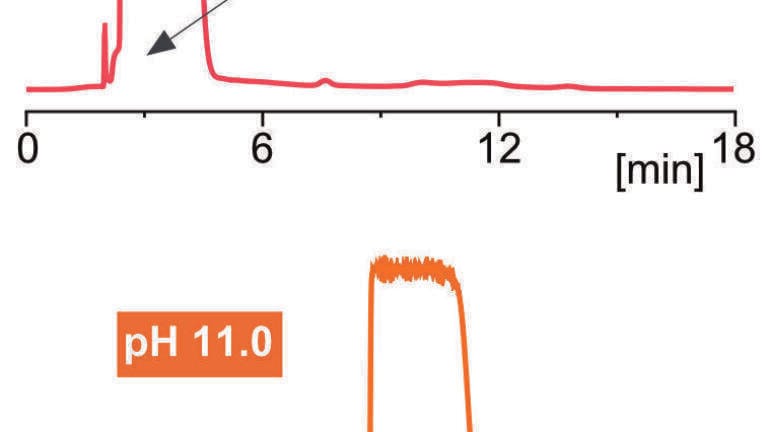
The example shown in the figure, illustrates two preparative chromatograms for the purification of alkaloid tryptamine, from an impurity that elutes before the compound of interest. On the left hand side, the chromatographic result shows the sample is loaded onto the column equilibrated at pH of 2.5. Here the impurity elutes under the main amine peak affecting productivity and yield. On the other hand, the chromatographic result shown on the right hand side indicates that as amines are better retained under basic conditions, it is possible to separate the impurity that elutes ahead of the main peak and therefore obtain better purification results. These results exemplify the benefits of exploring pH as an option when carrying out preparative chromatography and choosing a stationary phase material that can withstand a wide range of pH.
Designed to address analytical and preparative chromatography under low, neutral and high pH, in combination with also aggressive inorganic buffers and/or elevated temperatures, Kromasil EternityXT UHPLC and HPLC family of columns are provided in a wide range of particle sizes, between 1.8 µm and 10 µm, and analytical to preparative dimensions for fast turnaround, easy method transfer and seamless scale-up from the discovery stage to manufacturing.
For further information please click here.


 Product directory