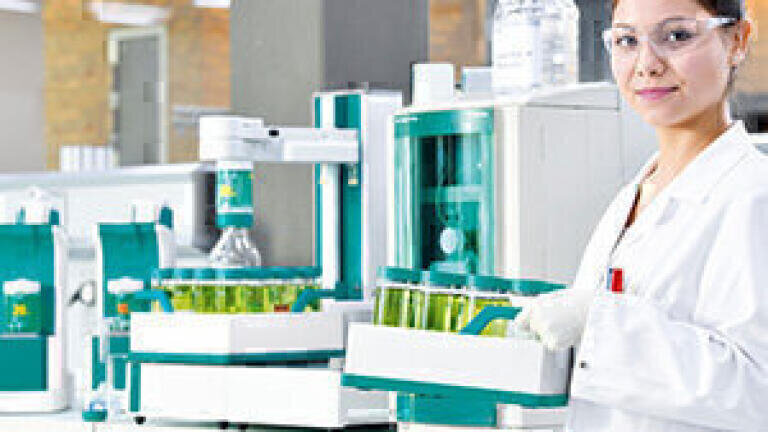
This eLearning demonstrates how to consolidate routine analysis of multiple parameters on a modular platform.
Increasing numbers of samples, multiple parameters to be determined, mandatory compliance with national and international standards – water works, bottlers of mineral water and some sectors of the process industry all face the same challenge: How to cope with more analytical tasks while human resources in the laboratory are limited?
In this eLearning session we demonstrate how automation can help you keep pace with today’s complex QC requirements in the water industry. Learn how all your standard measurements and titrations but also parameters like turbidity, color, and all critical ions can be consolidated on a modular, fully automated analytical platform – including dedicated sample preparation. Best practice examples are given from modern water laboratories that were able to achieve time savings of up to 60% while safeguarding robust, consistent results of their daily routine analytics.
Participate in this eLearning to learn:
Heike is Product Manager Titration Automation at the Competence Center for Titration at Metrohm International Headquarters, Herisau, Switzerland. She has more than 21 years of work experience with titration. During her time with Metrohm, Heike used to work as an Application Specialist Titration with focus on method and application development for virtually every industry sector. For more than 16 years, she has been responsible for the product management of automated titration systems.

Jennifer Lüber is the Product Specialist for Titration/TitrIC at Metrohm AG in Switzerland. She finished her apprenticeship as a Lab Technician at Metrohm AG in 2014. Afterwards, she was involved in projects related to column development, and worked in the laboratory for a short time at Metrohm UK. In 2015, Jennifer returned to Metrohm AG to join the competence center for titration, eventually taking responsibility for the TitrIC systems in 2018. Jennifer received her bachelor’s degree in business process management in 2020.
Tom has 35 years of experience in the petroleum industry, specialising in the delivery of forensic and problem solving /method development capabilities for BP Fuels and Lubricants businesses globally. He was also a member of the BP Science Council representing Analytical Science and led a BP wide Analytical Science network.Tom has published over 30 citable papers, 4 book chapters and has given over 60 presentations at conferences. He is a past Vice President of the Royal Society of Chemistry (RSC) Analytical Division and a past Chairman of the RSC Separation Science Group. In addition, Tom is a recipient of the Silver Jubilee Medal by the Chromatographic Society and a technical achievement award by the Energy Institute.

 Product directory









.jpg)