Electrophoretic separations
Published over 14 years ago. See the latest and most current information on Electrophoretic separations.
The culturing time for identifying Staphylococcus aureus in blood cultures has been significantly reduced, thanks to a new process that identifies the bacterium by combining isotopic labelling with specific bacteriophage amplification.
Researchers from the Georgia Institute of Technology and the Centers for Disease Control and Prevention (CDC) developed the new laboratory test in order to cut down the time it takes to multiply bacteria before it can be identified in a blood sample.
Detection currently takes around 18 to 24 hours, but the new method reduces culturing time to just two hours.
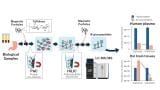
A nitrogen-15 labelled bacteriophage targets living Staphylococcus aureus cells, replicating inside the bacteria at a far quicker rate. The phage proteins are easily detected by using mass spectrometry with a protein identification technique that is based on the mass and charge ratio of peptide fragments.
Carrie Pierce, one of the authors on the paper and research chemist at the CDC commented: "The simplicity of sample preparation, the low cost of required reagents and the increased availability of mass spectrometers in clinical laboratories make this new method a cost-effective way to rapidly and effectively detect staph infections, which must be treated quickly to prevent spread of the disease."
Posted by Fiona Griffiths




 Product directory