Environmental laboratory
Published over 16 years ago. See the latest and most current information on Environmental laboratory.
Monitoring hydrogen in the presence of other gases is an important requirement in many process industries for both process optimisation and for safety. These measurements are often difficult or costly to perform, however, Milton Keynes based instrumentation specialist Quantitech is finding a broad spectrum of applications for a new technology from the United States that resolves these issues.
Commenting on the market for hydrogen sensing, Quantitech Sales Director Dominic Duggan says, "Hydrogen monitoring does not take place in many applications because of the problems or costs associated with the available technologies, (e.g. lack of specificity) however, the new sensors from H2scan resolve these issues offering significant advantages in process control and safety management. For example, we have recently delivered a large number of hydrogen detectors to monitor potentially explosive concentrations in battery charging rooms."
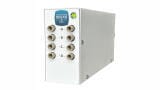
The U.S. company H2scan has developed inline, solid-state palladium-nickel based sensors that are highly selective to hydrogen, do not require oxygen to operate, and can detect hydrogen in concentrations from a few ppm to 100%.
Hydrogen has the potential to be an important source of clean fuel in our energy-driven economy. The use of hydrogen (H2) is widespread in both traditional applications, such as petroleum refineries, and
growing rapidly in newer sectors such as fuel cells and power generation. Global hydrogen consumption grew from 21 million metric tons (Mmt) in 2005 to more than 32 Mmt in 2007. Global hydrogen usage is expected to surpass 50 Mmt by 2012 and is expected to exceed 79 Mmt by 2016.
Currently, over 90% of all hydrogen produced is used in the petroleum refining industry, where continuous monitoring of hydrogen is highly desired to improve both the quality and yield of hydrocarbonbased fuels. Because of hydrogen’s combustible and explosive properties, accurate leak detection is also important for safe hydrogen transport, storage, and use.



 Product directory