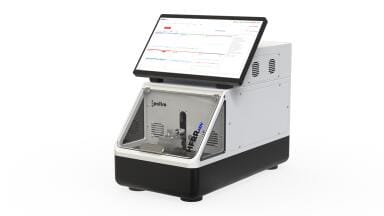
Olefin content in refined gasolines needs to be kept low in order to prevent deposits from forming in fuel systems. These deposits will decrease the efficiency of engines or even prevent them from starting. Olefins as a class are reactive species – conjugated diolefins especially so – and will polymerize in high enough concentrations. Traditional methods to measure olefins, such as ASTM D1159 (bromine number by titration) and UOP-326 (maleic anhydride) are archaic, inefficient, and widely variable in both accuracy and precision. Even more advanced techniques like detailed hydrocarbon analysis (DHA) are not without their own issues. On the other hand, GC-VUV uses the unique absorbance spectra of compounds and the absorbance features characteristic for each class of compounds (e.g. paraffins, olefins, aromatics) to accurately and repeatably determine PIONA values, which include olefin content, for gasoline-range fuels.

Jean-Francois Borny graduated from Texas A&M University with degrees in Chemistry and Computer Science. He has been in the analytical chemistry field for over 30 years, working in refineries, instrument manufacturers, commercial labs, and pharmaceutical and petrochemical companies. Currently the Analytical Services Manager at McDermott’s Lummus Technology, Jean-Francois travels worldwide presenting, training and setting up laboratories supporting the process technologies developed at Lummus Technology Research facilities in Texas.

Alex Hodgson is currently the senior applications chemist at VUV Analytics, Inc. Prior to joining the VUV team, he spent four years as a chemist with the Center for Disease Control (CDC). Alex earned a B.S. in biochemistry from the University of Texas at Austin and an M.S. in biochemistry at the Georgia Institute of Technology. His current research focuses on utilizing vacuum ultraviolet detection for the development of fuels analysis applications among a variety of other GC-VUV related endeavors.

Tom has 35 years’ of experience in the petroleum industry, specialising in the delivery of forensic and problem solving /method development capabilities for BP Fuels and Lubricants businesses globally. He was also a member of the BP Science Council representing Analytical Science and led a BP wide Analytical Science network. Tom has published over 30 citable papers, 4 book chapters and has given over 60 presentations at conferences. He is a past Vice President of the Royal Society of Chemistry (RSC) Analytical Division and a past Chairman of the RSC Separation Science Group. In addition, Tom is a recipient of the Silver Jubilee Medal by the Chromatographic Society and a technical achievement award by the Energy Institute.



 Product directory