Bioanalytical
Published over 14 years ago. See the latest and most current information on Bioanalytical.
Gas chromatography-mass spectrometry coupling has been found to yield significantly more information for analysis of complex reactions.
When it comes to these complex reactions, thermogravimetric analysis alone can often fail to achieve the required results. Analysing the release of gases from additives made of polymer blends, for example, would not be sufficiently compiled with the use of only thermogravimetric analysis.
However, coupling the simultaneous thermobalance (TGA or TGA-DSC) to a gas chromatograph-mass spectrometer (GC-MS) can unveil many more findings, and also helps in identifying the components released.
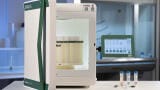
One such system is Netzsch TGA and Simultaneous TGA-DSC (STA), which are arranged vertically with the sample above the balance. This enables the gases to flow in their natural direction, which is ideal for coupling gas analysis equipment to the top of the furnace.
In collaboration with JAS (Joint Analytical Systems, GmbH), Netzsch's developments allow reaction gases from the STA to be fed directly into the GC valve box by a heated transfer line. The substances then arrive in the GC column via a loop, where they can be separated and analysed with a mass selective detector.


 Product directory