HPLC, UHPLC
Published over 5 years ago. See the latest and most current information on HPLC, UHPLC.
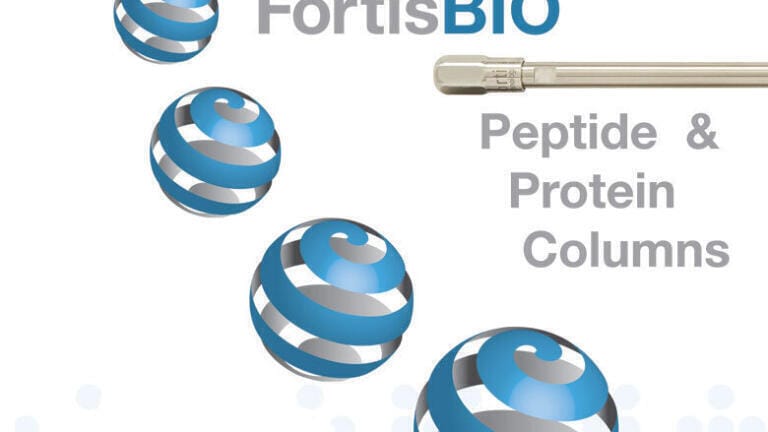
Fortis Technologies brings new selectivity’s to its FortisBIO range by adding a Phenyl stationary phase as well as a SAX and SCX choice. These new bonding’s compliment the FortisBIO Protein C18, C8 and C4 hydrophobic options. The phenyl group allows for pi-pi interactions to be used to resolve more complex proteins and peptide samples. The ion-exchange phases help separate charged species or for the option to use 2D chromatography for highly complex samples such as trypic digests.
These additions allow more selectivity to be achieved than just the use of hydrophobic stationary phases alone. Proteins and peptides require a combination of wide pore, stable silica template along with varying hydrophobicity’s. Having the option to have non-hydrophobic interactions between stationary phase and analyte, selectivity can often be increased greatly.
Protein samples are often low abundance, requiring high efficiency stationary phases and sharp peaks to aid resolution and sensitivity gains. The FortisBIO phenyl is available as 1.7µm UHPLC particle size as well as the more traditional 3µ and 5µm analytical sizes. The 1.7µm particle allows for the biggest increase in peak height when ultimate sensitivity is required for low abundance proteins.
FortisBIO is just one option for the separation of proteins and peptides, the companies SpeedCore BIO columns are also available for those that prefer the option for a core-shell particle.
To learn more visit the companies website or contact us via email.

 Product directory