GC, MDGC
Published over 11 years ago. See the latest and most current information on GC, MDGC.
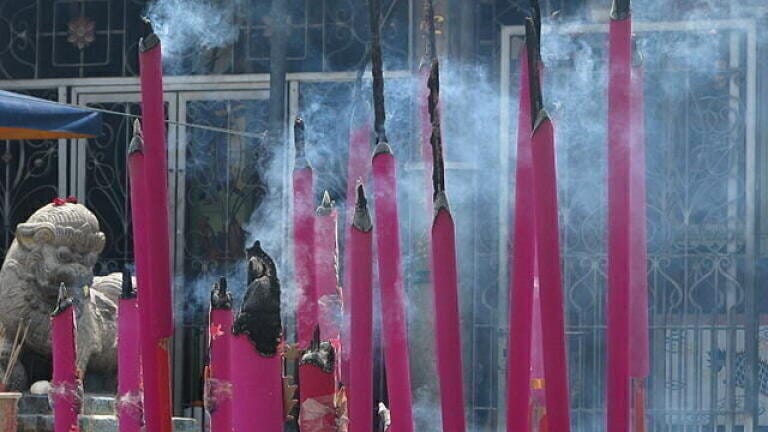
Incense is an easily available material used to generate an aroma. It has many uses including in religious ceremonies or to hide bad odours. Incense that is burnt is generally made by combining essential oils with plant material and making a paste that is then packed around a bamboo taper or shaped into a cone. After lighting the flame is blown out and the glowing embers release the aromatic smells of the plant and oil.
A recent study into incense and cigarettes has generated headlines like “Incense could be ‘more harmful than cigarette smoke’” and “Incense smoke may cause same health effects as cigarettes”. The headlines are for articles reporting on a study published in the journal Environment Chemical Letters titled “Higher cytotoxicity and genotoxicity of burning incense than cigarette”.
Behind the headlines — what can we learn from the science?
The team concentrated on looking at the total particulate matter made by burning incense indoors. Four types of incense and a cigarette were burnt and the smoke particles collected. The particles were characterizing using ELPI (Electrical Low Pressure Impactor), which can determine the size and concentration of the particles generated.
Burning incense generated particles described as fine and ultrafine — particles of these sizes are known to cause problems in lungs — they are small enough to get deep into the fine alveoli and cause blockages and irritations leading to breathing problems
The volatile chemicals released were analysed using gas chromatography in tandem with a mass spectrometer. Volatile organic chemicals (VOCs) are commonly determined by GC-MS, but with such a wide range samples producing VOCs — the sampling of them can be a problem. The issue is addressed in the article, Trace Level VOC Analysis in Different Sample Matrices.
Altogether, the team found 64 different compounds from the four incense sticks. The compounds found included essential oils and plant materials like lignin. Some of the compounds were toxins, but the majority would be described as irritants.
The mutagenicity, cytotoxicity and genotoxicity of incense smoke was compared to that of cigarettes using in vitro assays.
The trial found that the genotoxicity of one incense sample was higher than from the reference cigarette at the same dose and the incense particulate matter had a greater cytotoxicity on ovary cells from a hamster.
This is a really small study — so no conclusions can really be drawn from the results. Close scrutiny of the method shows that no allowance was made for the fact that cigarettes are smoked — incense isn’t.
It pays to look behind the headlines.

 Product directory






















.jpg)



.jpg)

.jpg)