Quantitative analysis has revealed that it is necessary to use more rigorous in vivo chemical cross-linking to stabilise histones containing post-translational modifications (PTMs).
In a study for the University of Arkansas for Medical Sciences, published in the Journal of Clinical Bioinformatics, scientists found that histones containing transcription activating PTMs exchange more rapidly compared to bulk histones.
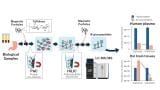
The team made the discovery using quantitative analysis methods including a combination of affinity purification and mass spectrometry which identified the amounts of chemical cross-linking required to prevent histone exchange during chromatin purification.
As a result it was found that histones containing transcription activating PTMs need a higher level of cross-linking to preserve the in vivo chromatin structure.
"The technique reported in Byrum et al. 2011 and further analyzed here is relevant for a variety of genome-wide studies, and should be considered when preservation of in vivo chromatin content is essential for functional analyses," the report stated.





 Product directory