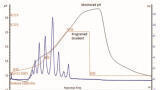
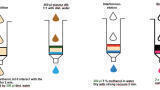
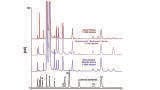
An investigation of Porous Graphitic Carbon (PGC) as a stationary phase for the analysis of proteomic samples in a two-dimensional liquid chromatography (2D-LC) workflow is presented. A selectivity study performed on a standard mixture containing 15 peptides shows that the elution order obtained using PGC deviates significantly from conventional reversed phase selectivity. Furthermore PGC has been shown to retain and resolve small polar peptides otherwise unretained on standard reversed phase C18 stationary phases. The separation mechanism orthogonality compared to C18 combined with greater retentivity for polar analytes makes the use of PGC in 2 dimensional separations ideal. An analysis of a whole cell lysate by PGC prefractionation has been shown to result in an increase of nearly 6000 unique peptides compared with SCX as the first dimension separation of a 2D-LC-MS/MS experiment.



 Product directory