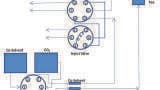
J. Calvin Giddings envisioned that a convergence of the respective benefits of gas chromatography [GC]—higher mobile phase diffusion and efficiency—and liquid chromatography—higher selectivity via orthogonal modes of separation—might be accomplished by using a supercritical fluid as the mobile phase, together with LC stationary phases. Supercritical carbon dioxide (CO2) is a ‘green’, non-toxic, inexpensive, highly compressible solvent; its low viscosity may decrease operating pressure while increasing efficiency for a given particle size and linear velocity.1 By comparison, typical normal- and reversed-phase liquid chromatography (NPLC and RPLC) mobile phases contain toxic, higher viscosity, compression-resistant organic solvents. HPLC-grade solvents, especially those used for RPLC, including water, are very expensive.


 Product directory