Preparative
Published over 17 years ago. See the latest and most current information on Preparative.
Drilling for oil or gas holds many challenges. Keeping pipes free of scale deposits is one of them. This involves the monitoring of ionic components in produced water, a task that is best handled by ion chromatography (IC).
Produced water is water trapped in underground reservoir rocks and is brought to surface along with the crude oil and gas. Besides dispersed oil droplets and dissolved organic compounds, produced watermainly contains significant amounts of inorganic cations such as calcium,magnesium, bariumand strontium, and anions such as carbonate, bromide and sulfate. Precipitation of the corresponding salts often leads to the formation of scale deposits that can clog pipes.
For this reason it is of paramount importance to determine the inorganic constituents of produced water in order to choose the correct dosing of scale inhibitors. While the anions bromide, sulfate, acetate and butyrate can reliably be determined by suppressed conductivity detection, the cations magnesium, barium and strontium are determined by non-suppressed conductivity detection.
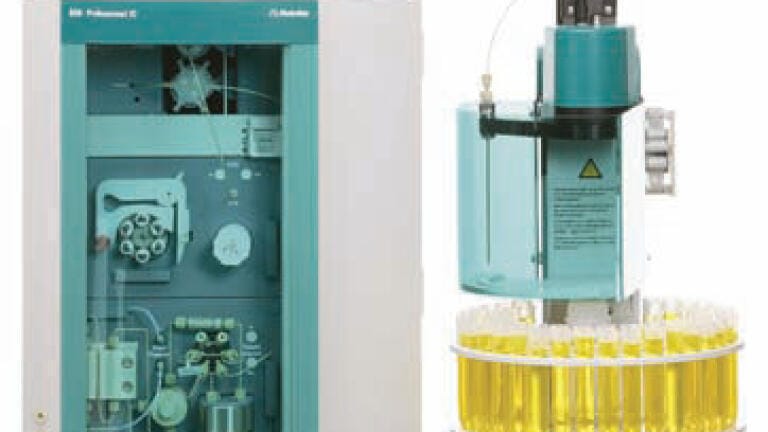
Of the numerous analytical techniques for the determination of ionic species, IC is the best suited in terms of selectivity, flexibility, automation and ruggedness. Take advantage of Metrohm’s complete offer of IC systems and stay on course to reach your production goals.



 Product directory