HPLC, UHPLC
Published over 4 years ago. See the latest and most current information on HPLC, UHPLC.
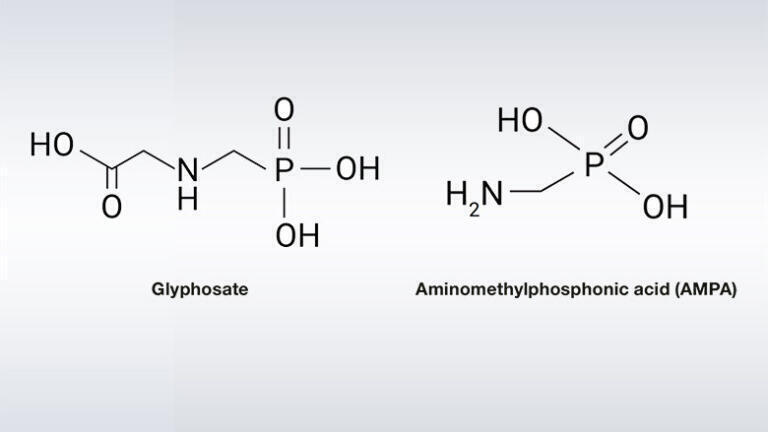
Glyphosate is the world’s most used herbicide. Since the 1970s it has been used to eliminate weeds in a non-selective way which means that all non-resistant plants are killed by its use. This resulted in the cultivation of genetically modified plants in order to make them glyphosate-resistant. Aminomethylphosphonic acid (AMPA) is the main metabolite of glyphosate and is found more often in the environment than glyphosate. It is not only released into the environment by the metabolism of glyphosate, but also by the degradation of other urban phosphonates which is why higher concentrations in the environment are commonly known.
Due to its widespread use, glyphosate and its metabolite AMPA are also present in ground and surface water. How this might influence the human health, is still discussed which is why their analysis is an important topic. Glyphosate and AMPA are both highly polar compounds which make them difficult to retain on C18 columns. The derivatisation with FMOC-Cl (fluorenmethyloxycarbonyl chloride) according to DIN ISO 16308 is used to lower the analytes’ polarity and therefore increase their retention. DIN ISO 16308 is recommended to be applied to the analysis of drinking, ground and surface water, whereas for salt and sea water the applicability has to be checked. If the detection capability of the mass spectrometer (MS) is sufficient, no enrichment of the analytes is needed.
According to DIN ISO 16308 the water sample is mixed with isotope labelled internal standards, a chelating agent, buffer and FMOC-Cl in order to perform the derivatisation. After neutralisation, the sample is filtered and can be used for the subsequent HPLC analysis.
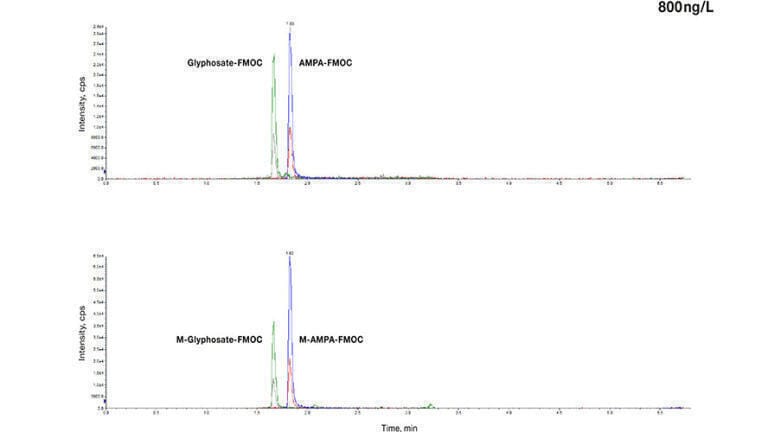
In this application note, the analysis of FMOC-derivatised glyphosate and AMPA is shown using a YMC-Triart C18 UHPLC column. Due to the highly robust hybrid silica base particle of YMC-Triart the challenging pH value of 9.5 can easily be used. Since the detection capability of the MS was sufficient, no enrichment was needed. Analyses were performed for very low concentrations of 30 ng/L up to 800 ng/L. Stable isotope M-AMPA-FMOC and M-glyphosate-FMOC were used as internal standards.
Application data by courtesy of: Dr. Dirk Skutlarek, Universitätsklinikum Bonn, Institut für Hygiene und Öffentliche Gesundheit, Bonn, Germany.

 Product directory