Bioanalytical
Published over 15 years ago. See the latest and most current information on Bioanalytical.
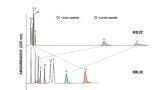
It is established that for electrospray LC-MS(/MS) assays, co-eluting phospholipids may cause ion suppression which can lead to method inconsistency and reduced sensitivity [1, 2]. The abundance of phospholipids in cell membranes means they are a common contaminant of analyses involving plasma extraction.
Therefore, avoiding co-elution of phospholipids and analytes during a chromatographic run, or removing phospholipids completely during sample preparation is highly desirable. Typically the method development process for an LC-MS/MS bioanalytical assay follows the sequence of MS-ion optimisation, development of LC conditions, MS source optimization and then development of extraction.
It is only at this stage that the effectiveness of sample clean-up combined with chromatographic selectivity is demonstrated. If a substantial matrix effect or interference is present, it may be necessary to re-develop the LC method completely, which is both resource and cost inefficient.


 Product directory