Columns (LC)
Published over 14 years ago. See the latest and most current information on Columns (LC).
Hydrophilic interaction liquid chromatography or HILIC is a technique that has been around for quite some time, based somewhere between reversed-phase (RP) and normalphase (NP) chromatography.
Understanding HILIC
A highly polar stationary phase, often bare silica, is used with largely a non-polar mobile phase system (water acting as a very strong solvent in HILIC) to provide retention of polar or hydrophilic molecules.
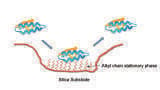
The mechanisms of HILIC are still being fully explored but it is quite well accepted now that the analyte partitions between the mobile phase and a water enriched layer at the surface of the stationary phase. The surface of the stationary phase when underivatized forms this layer with water due to the exposed silanols. Also thought to be part of the retention mechanism is ion-exchange and hydrogen bonding dependant upon the analyte in question. For example, basic analytes with positive charge
will partition into the water layer at the surface, but will also have a cation exchange mechanism with the silanols at the phase surface.

 Product directory